
8 min read
HVAC Sales Training: Why Menus Beat Scripts (2026)
The New Flat Rate : Jun 18, 2026 8:14:01 AM
Table of Contents
HVAC Sales Training: Why Menus Beat Scripts (2026)
Most HVAC technicians are trained to fix systems, not sell them. That gap is costing companies thousands of dollars per service call — not because their techs are bad at their jobs, but because fixing things and selling things are two completely different skill sets, and most training programs treat them like the same problem.
The good news? Closing more jobs doesn't require a new personality, a script your techs will use for a week and then abandon, or pressure tactics that make customers uncomfortable. It requires the right combination of training and structure — and the best HVAC companies are getting both right.
This guide covers what effective HVAC sales training actually looks like, why it breaks down at scale, and what top-performing contractors are doing differently to increase average ticket consistently across their entire team, not just their best tech.
What HVAC Sales Training Actually Covers
Before anything else, it's worth understanding what good residential HVAC sales training is designed to do. The goal isn't to turn technicians into salespeople in the traditional sense — it's to close the gap between diagnosing a problem and helping a homeowner understand their options clearly enough to make a confident decision.
The best HVAC sales training programs focus on a handful of core skills.
Discovery and listening. Most techs talk too much and listen too little. Effective training teaches them to ask the right questions before touching anything — how long have you been in the home, what problems have you noticed, what matters most to you about your HVAC system — and to actually wait for the answers. Anything the tech says, the customer may doubt. Anything the customer says themselves, they believe completely.
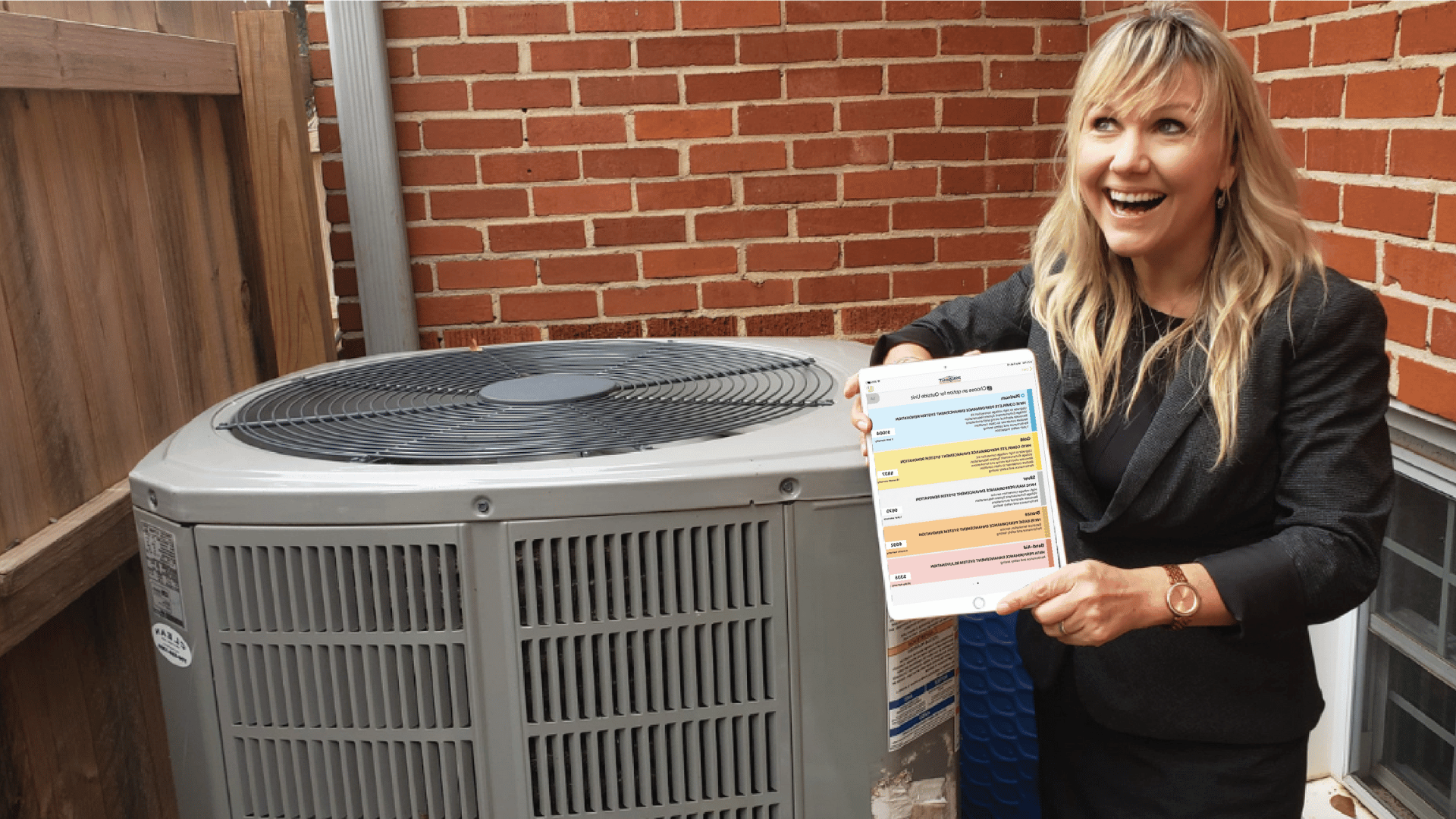
Presenting options, not ultimatums. Giving a homeowner one price forces a yes-or-no decision. Training that teaches techs to present multiple options — a good, better, and best — shifts the customer's question from "should I buy this?" to "which one makes sense for me?" That's a fundamentally different conversation, and it changes close rates significantly.
Talking about money without flinching. Most techs became HVAC professionals because they're good with systems, not because they enjoy discussing a $9,000 equipment replacement with a homeowner standing in their kitchen. Training helps them frame pricing confidently, introduce financing naturally, and stop apologizing for the number.
Handling objections. "I need to think about it," "I'm getting other bids," "that's more than I expected" — these are predictable. Good HVAC sales training gives techs a practiced, non-pushy way to respond to each one so they're not improvising under pressure.
Following up consistently. Most jobs are won on the second or third contact, not the first. A tech who hands a homeowner three options in writing and follows up 48 hours later will close more work than one who never calls back.
Ongoing coaching, not a one-time workshop. Sales is a muscle. It atrophies without practice. The most effective programs build in weekly role-plays, ride-alongs, and recorded call reviews so the skills get reinforced over time rather than fading after a training day.
For a deeper look at the specific techniques behind each of these, we've covered them in detail in HVAC Sales Tips: 7 Proven Techniques to Close More Jobs in 2026.
Why Training Alone Breaks Down at Scale
Even when HVAC companies invest in solid sales training, they run into the same wall: the results are inconsistent. One tech converts 60% of his calls. Another — equally well-trained — sits at 30%. A homeowner gets a confident, thorough presentation from one tech on Tuesday and a rushed, awkward one from a different tech on Thursday. Same company. Same training. Completely different customer experience.
This happens for a predictable reason. Most residential HVAC sales training is designed to develop individual skill. It assumes that if you train a person well enough, they'll execute consistently. But human performance doesn't work that way. Confidence fluctuates. Scripts feel natural one day and stilted the next. A tech who had a rough morning, three callbacks, and a difficult homeowner before noon is not in the same headspace as the same tech on a good Tuesday.
There's a deeper structural problem too: 80% of HVAC technicians dislike selling. That's not a lack of training — it's a reality of who goes into the trades. People become HVAC techs because they're skilled with their hands, they like solving mechanical problems, and they want to help people. Being put in a position where they feel like they're pitching is genuinely uncomfortable for the majority of them. Training helps, but it doesn't eliminate the discomfort. It just gives them better scripts to recite while they're uncomfortable.
The inconsistency also creates pricing problems. When individual techs quote from memory or from different versions of a price sheet, the numbers vary. A homeowner who compares notes with a neighbor discovers they were quoted differently for the same job. That erodes trust — in the tech and in the company.
Technical skill and business acumen are two different things, and expecting training alone to bridge that gap puts the weight of your revenue on individual performance. That's a fragile model, especially as you grow and add more trucks.
What the Best HVAC Companies Are Adding
The contractors who achieve consistent ticket growth across their whole team — not just their top tech — have figured out that sales training and a sales system are two different things, and you need both.
Sales training develops individual skill: how to listen, how to communicate clearly, how to handle a customer who pushes back. That work still matters, and it's irreplaceable. A tech who can have a genuine, comfortable conversation with a homeowner will always outperform one who can't, everything else being equal.
But a sales system removes the dependence on individual performance for the outcome. It creates a structure that works consistently regardless of which tech shows up on the call — one that doesn't rely on confidence, memory, or personality to drive results.
The most effective structural change most HVAC companies can make is moving to menu-based pricing: a digital price book that presents homeowners with multiple clearly explained options on every call, automatically.
Here's why this works so well in practice. When a tech hands a homeowner a physical or digital menu of options — typically three to five tiers for any given service or repair — the psychology of the interaction shifts. The homeowner is no longer deciding whether to buy. They're deciding which option fits their needs and budget. Research on consumer choice consistently shows that when presented with multiple options, most people choose a middle tier. That means presenting options isn't just better for the customer experience — it reliably increases average ticket size without any additional selling by the tech.
More importantly, it removes the awkward moment. The tech isn't pitching. They're not trying to read the homeowner's budget and guess what they can afford. They're showing a menu — the same way a service advisor shows repair options at a car dealership — and letting the customer decide. As we've noted before on this blog: the question shifts from "should I buy this?" to "which one is right for me?" That is a fundamentally different conversation.
The consistency benefit is just as significant. When every tech in your fleet presents from the same menu, pricing is uniform. There are no discrepancies between what one homeowner paid and what their neighbor was quoted. Customers get a professional, predictable experience, and owners get the margin protection that comes from pricing that doesn't vary tech to tech.
A second structural piece worth adding is a standardized follow-up system. Not a reminder to follow up — an actual system. Who calls back, when, what they say, how they track it. The companies that win are the ones that follow up like they mean it: a call within 48 hours, a second touch at a week, a long-term nurture for customers who aren't ready yet. "I need to think about it" is not a no — it's a not yet. The system captures the jobs that individual follow-through would let slip.
Training That Complements a System (Not Competes With It)
Once a pricing system is in place, the role of sales training changes — and in a lot of ways it becomes more effective, not less.
Without a system, training has to carry everything: the pricing, the presentation, the close, the objection handling. That's a lot of weight. With a system handling the pricing structure and the option presentation, training can focus on what humans actually do best: building trust, reading the room, communicating clearly, and making the customer feel genuinely helped rather than sold to.
The skills worth investing in, alongside a menu pricing structure, are the ones that improve the human side of the call. Teaching techs to stop selling from the driveway — making assumptions about what a customer can or can't afford before they've walked the home and asked a single question. Teaching them to lead with solutions rather than parts, framing a recommendation in terms of what the homeowner actually cares about: comfort, lower bills, fewer breakdowns, peace of mind. Teaching them to handle the moments when a customer pushes back — not by defending the price, but by acknowledging the concern and walking through the value.
These skills don't conflict with a menu system. They're what make the menu work better. A tech who presents options confidently and can answer a follow-up question clearly will close more than one who taps through a menu and then goes quiet. The system creates the structure. Training fills it with good judgment.
And critically: training that is delivered in small, consistent doses — weekly role-plays, short call reviews, ticket-by-ticket coaching — compounds over time in a way that a two-day seminar never will. The companies that train consistently outperform their peers on close rate and average ticket. The ones that treat training as an event rather than an ongoing practice watch their results plateau.
What to Measure to Know If It's Working
One of the most overlooked parts of HVAC sales training — and sales systems — is measurement. You can't improve what you don't track, and too many contractors are running on gut feel rather than data.
The metrics worth watching closely are:
Average ticket value. This is the clearest indicator of whether your techs are presenting the full range of options or defaulting to the lowest-cost fix. If average ticket is flat or declining, the options aren't being presented — or they're being presented without confidence.
Close rate on estimates. What percentage of quotes are converting to booked jobs? A low close rate can mean a pricing issue, a communication issue, or a follow-up issue. Breaking it down by tech tells you whether it's a training problem or a system problem.
Maintenance agreement conversion rate. Maintenance agreements are the single best retention tool in the HVAC industry, and a tech who consistently offers them on service calls is worth considerably more to a company's long-term revenue than one who doesn't. If your conversion rate is low, it's almost always a training issue — the offer isn't being made consistently.
Revenue per technician. Are your techs operating at similar levels of efficiency and average ticket, or is there significant spread? A wide spread suggests the results are personality-dependent rather than system-dependent — which is a sign the structure isn't doing enough of the work.
Tracking these consistently lets you spot problems early, coach the right people on the right things, and make growth decisions based on evidence rather than instinct. It also makes training more targeted: instead of running everyone through the same program every six months, you can focus coaching on specific gaps for specific techs.
For more on the broader metrics that drive HVAC business growth, see HVAC Business Growth: A Practical Guide for Contractors at Every Stage.
The Bottom Line
Effective HVAC sales training isn't about turning your techs into salespeople. It's about giving them a structure that makes every call consistent, a communication skillset that builds trust with homeowners, and a pricing system that presents options professionally without putting the weight of the sale on their shoulders.
The companies that grow their average ticket reliably — across their whole fleet, not just their top performer — are the ones that have figured out that training and systems aren't the same thing. Training develops people. Systems make results repeatable. You need both.
Start with the human skills: listening before talking, presenting options instead of ultimatums, handling objections without flinching, following up with intention. Then build the structure underneath that makes those skills easier to apply on every call — not just the good days.
That combination is what separates a company that sells from a company that scales.
See How The New Flat Rate Works for HVAC Companies
The New Flat Rate is a menu pricing system built specifically for HVAC contractors. It puts a professional, digital price book in your tech's hands on every call — one that presents customers with multiple clearly explained options automatically, requires no sales skills to use, and typically increases average ticket 50–200%.
Most contractors see results in the first month. Setup takes less than 24 hours. It works alongside ServiceTitan, Housecall Pro, and the other field service tools you're already using.
"Giving consumers choices is fantastic in our industry — not something we have ever done. TNFR is a game changer." — Stephen Quinn, JD Swallow Heating and Cooling
See how The New Flat Rate works for HVAC →
Read More