

 Melody Chaney
An HVAC proposal template is a document that shows a customer’s repair or replacement options, prices, warranty, and terms before work begins. Use the filled-in example below, then customize your own proposal with The New Flat Rate’s free proposal builder.
The New Flat Rate is menu pricing software and training for home service contractors. The free builder lets you select three options—Good, Better, and Best—or five options—Basic, Bronze, Silver, Gold, and Platinum. You can rename the options to match your business.
Last updated: Nov 2, 2026
Key takeaways
- Start with the inspection findings and the homeowner’s priorities.
- Show what each option includes and the complete price.
- List equipment details, installation scope, warranty, and payment terms.
- Use three or five options and record the customer’s selected package.
Customize your free HVAC proposal template
Choose HVAC in the builder, select three or five options, and add your company information and logo. Review the live preview before using the PDF output. Fields you leave blank stay fillable on the PDF, so your team can complete the details for each job.
Open the free HVAC proposal builder
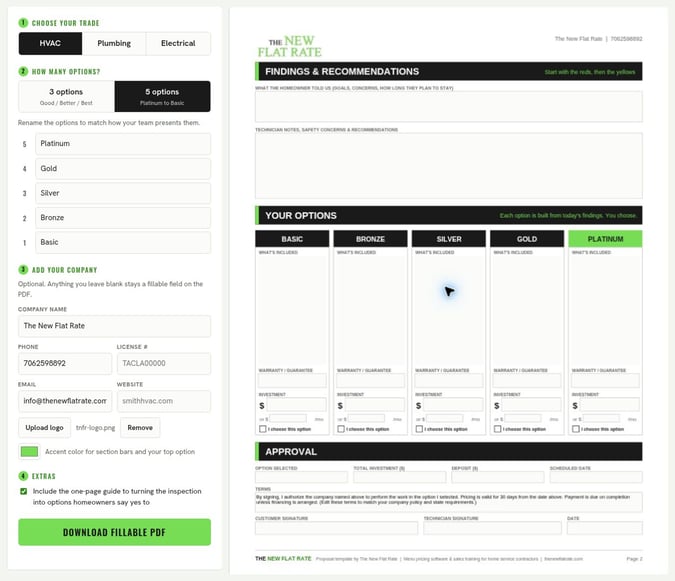
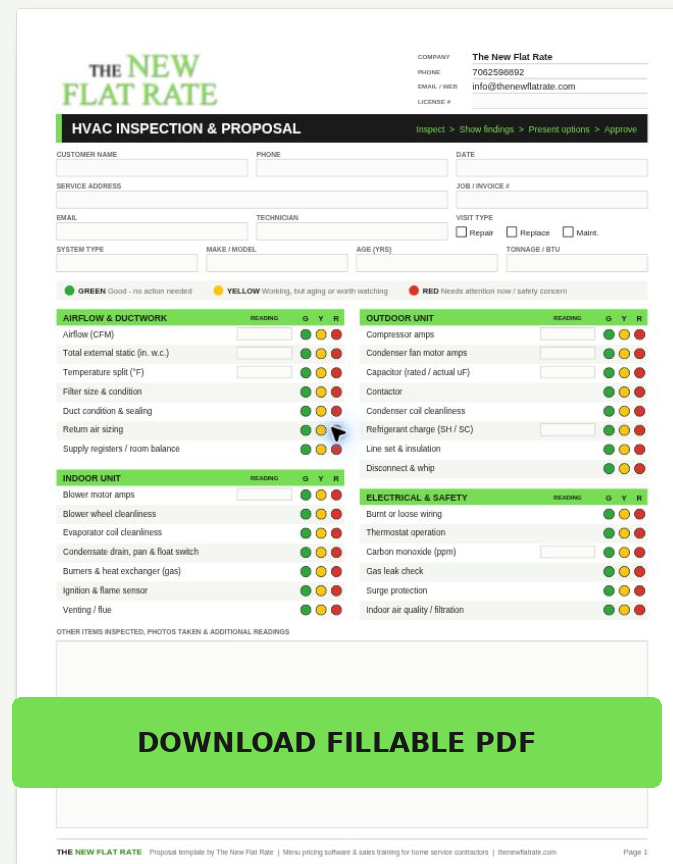
HVAC proposal builder: choose your trade, select three or five options, and add company details. The inspection page gives your team a place to record findings.
What should an HVAC proposal include?
An HVAC proposal should identify the customer, explain the diagnosis, define the work, and show the available choices with prices and terms. Equipment, installation, warranty, schedule, and approval details should be specific enough for the homeowner to understand what they are choosing.
- Company and customer details: business contact information, applicable license details, customer name, and service address.
- Proposal details: proposal number, issue date, expiration date, and technician’s name.
- Inspection findings: measured conditions, the diagnosed problem, and the homeowner’s goals.
- Equipment: manufacturer, exact model numbers, capacity, efficiency ratings, and included controls.
- Scope: removal, installation, connections, testing, cleanup, disposal, and required permit responsibilities.
- Options and totals: what changes between packages and how taxes and fees are handled.
- Warranty: separate manufacturer coverage from your company’s labor coverage.
- Timeline: expected duration, access needs, and scheduling dependencies.
- Payment and changes: deposit, balance, financing if offered, exclusions, and written approval for added work.
- Acceptance: selected option, approved total, customer signature, contractor signature, and date.
What does a good, better, best HVAC proposal look like?
A good, better, best HVAC proposal shows three suitable solutions with clear differences in equipment, comfort features, or service. This fictional example covers replacement of a central cooling system; a completed assessment must confirm equipment sizing and compatibility before the final proposal is approved.
Example contractor: Sample Comfort Company. Customer: Morgan Example. Proposal: HVAC-301. Issued: October 21, 2026. Valid through: November 20, 2026. All amounts, package features, and warranty terms below are illustrative—not TNFR pricing, customer results, or market-rate recommendations.
| Item | Good | Better | Best |
|---|---|---|---|
| Equipment tier | Matched single-stage cooling system | Matched two-stage system and compatible controls | Matched variable-capacity system and compatible controls |
| Included work | Common installation scope below | Same required scope as Good | Same required scope as Good |
| Illustrative total | $9,000 | $11,000 | $14,000 |
| Coverage | Illustrative 1-year labor coverage; actual manufacturer terms attached separately | Same warranty treatment | Same warranty treatment; 2 scheduled maintenance visits within 12 months |
| Financing | Not included in this example | Not included in this example | Not included in this example |
| Taxes and fees | Included in this fictional total | Included in this fictional total | Included in this fictional total |
Common scope in every option: remove and dispose of the old equipment; install the selected matched system and compatible controls; complete required connections, applicable permit work, startup, testing, and cleanup. Include all mandatory safety and code work in every applicable option. Specify the actual manufacturer, model numbers, capacity, refrigerant, and certified efficiency rating before presenting a firm offer.
Sample price breakdown: Good totals $9,000. Better adds a $2,000 equipment and controls allowance, totaling $11,000. Best adds a further $3,000 allowance for the specified variable-capacity system, compatible controls, and included maintenance, totaling $14,000. These are fictional package differences, not an estimating formula.
Sample schedule: one working day after equipment, permit, and crew availability are confirmed. Sample payment: balance due at completion. Exclusions: unlisted duct replacement, electrical service upgrades, concealed damage, and structural repairs; additional scope requires a written price and customer approval.
Acceptance: Morgan Example selects Better at $11,000. Customer signature: __________________. Contractor signature: __________________. Approval date: __________________. Replace the example assumptions with the final job details before obtaining signatures.
How can I create an effective HVAC proposal template?
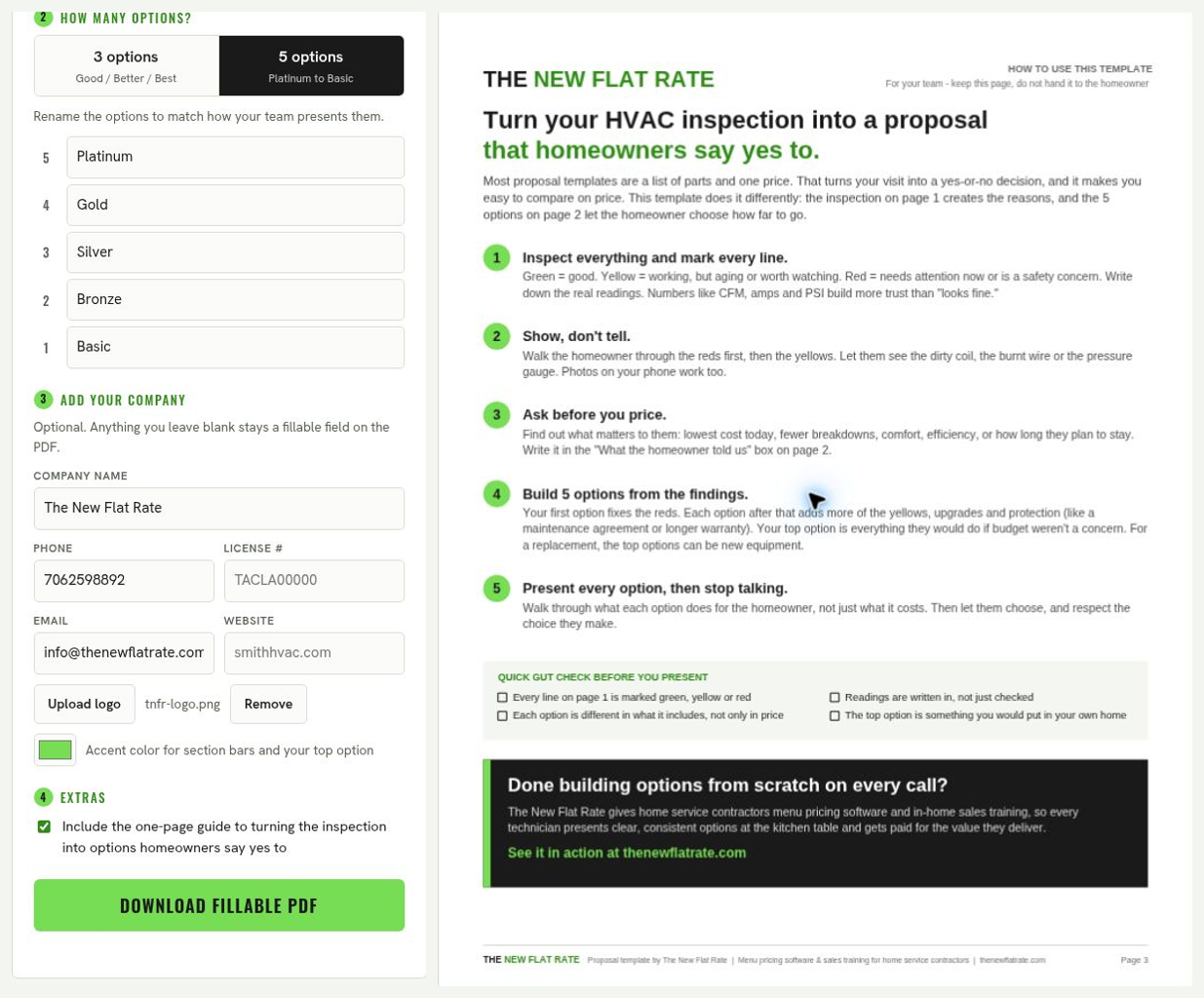
Create an effective HVAC proposal by turning inspection findings into a defined scope, suitable options, and a clear approval step. Build each package around the home and the customer’s priorities, then confirm equipment, costs, terms, and availability before presenting it.
- Inspect the system and document readings and conditions.
- Ask what matters to the homeowner: solving today’s problem, comfort, efficiency, noise, or future plans.
- Confirm whether repair, replacement, or both are appropriate.
- Define suitable equipment and the installation scope for each option.
- Calculate package prices from your actual costs and profit requirements.
- Explain each option and let the homeowner choose.
- Record the selected scope, total price, and written approval.
For replacement jobs, size the equipment from the home’s heating and cooling loads rather than a rule of thumb. The Department of Energy’s sizing guidance explains that oversizing can waste energy and affect comfort. Include your sizing basis in the job record and explain how it informs the proposed system.
Read DOE guidance on proper HVAC system sizing
Should you offer three HVAC options or five?
The free builder supports both layouts: three options for a simple good/better/best comparison, or five when you have five suitable choices to explain. Choose the layout that fits the job, then define meaningful differences; changing a label or a price alone does not create a useful option.
The default five-option names are Basic, Bronze, Silver, Gold, and Platinum. You can edit those names in the builder. Use the findings and the homeowner’s priorities to build the options, and keep required work consistent across every applicable package.
HVAC bid vs. proposal vs. estimate
An estimate projects the likely cost, a bid offers a price for a defined scope, and a proposal explains the work and choices offered. Businesses use these words differently, so state the price basis, inclusions, exclusions, and process for changes in the document itself.
| Document | Practical meaning |
|---|---|
| Estimate | An expected cost based on known conditions; state how it may change. |
| Bid | A price offered for a defined scope; state inclusions, exclusions, and validity. |
| Proposal | A written explanation of scope, options, prices, and approval terms. |
Five HVAC proposal mistakes to avoid
The most useful proposal makes scope, differences, pricing, coverage, and approval clear. The points below are practitioner guidance about reducing confusion; they are not measured claims about close-rate improvements.
- Listing “new AC” without equipment details. State the matched equipment, model numbers, capacity, efficiency rating, and controls.
- Comparing efficiency alone. Explain staging, comfort features, installation differences, and any maintenance included without promising unsupported savings.
- Leaving required work out of the base option. Every suitable option must include applicable safety and code work needed for its scope.
- Writing “full warranty.” List manufacturer coverage and labor coverage separately, including duration and exclusions.
- Leaving approval vague. Capture the selected option, final price, terms, and signatures before starting.
SEER2 means Seasonal Energy Efficiency Ratio 2, a measure of cooling efficiency under an updated test procedure. Use the rating for the actual matched equipment, not a generic claim for an entire product line. Do not promise a specific utility-bill reduction without a documented basis.
Read DOE information on central air conditioners and heat pumps
Confirm warranty terms against the actual equipment documentation. Rheem’s warranty resource, for example, supports product registration and warranty verification using a serial number. Your own labor coverage should be written separately so the customer knows who provides each commitment.
Check Rheem warranty and registration resources
How does menu pricing change an HVAC proposal?
Menu pricing presents clearly priced choices so the homeowner can select the level of work that fits their needs. A price book is the organized list of tasks and prices behind those choices; the proposal records the available options, terms, and customer approval.
A template helps organize the document. The New Flat Rate’s Menu Pricing System and training support a consistent way to build and present choices during service calls. Use the free builder as a starting point, then assess how your team will keep pricing and presentation consistent across jobs.
Explore the Menu Pricing Toolkit
See contractor training and coaching
Browse more free contractor templates
HVAC proposal template FAQs
How can I create an effective HVAC proposal template?
Start with customer details, inspection findings, scope, equipment, options, prices, warranty, and approval fields. Use a consistent layout, then fill it from the actual job. Check sizing, equipment compatibility, installation needs, and totals before presenting the choices, and record what the customer selects before work begins.
What is an HVAC bid template?
An HVAC bid template is a reusable layout for offering a price on a defined heating or cooling job. It should identify the equipment, installation scope, exclusions, payment terms, and validity period. If your price depends on site conditions or allowances, explain those assumptions instead of leaving the customer to infer them.
What belongs in a good better best HVAC proposal?
Include three suitable options with clear differences in scope, equipment, comfort features, or service. Show the complete price, warranty, and terms for each. All applicable required work must be included in every relevant option, and each package should address the diagnosed condition within its stated scope.
Are there any free HVAC proposal apps I can use?
The New Flat Rate offers a free browser-based proposal builder with HVAC selection, three- or five-option layouts, editable option names, company details, and a live preview. Its PDF fields can remain fillable. It is a template-building tool; evaluate separate software if you need broader estimating, job management, or pricing features.
What are the best HVAC proposal software options available today?
The best fit depends on the job you need the software to do: format proposals, estimate installation costs, manage work, or present priced choices during service calls. Compare those needs against each vendor’s current documentation. TNFR focuses on menu pricing and contractor training; this free builder provides a starting proposal layout.
Can I use five options instead of three?
Yes. Select five options in the builder to use Basic, Bronze, Silver, Gold, and Platinum, or rename them for your team. The three-option setting uses Good, Better, and Best. Offer only choices that suit the job, and explain the scope and benefit behind each package rather than changing the name alone.
Should an HVAC proposal include a maintenance plan?
Include a maintenance plan when it is relevant and your company actually offers it. State the visit count, duration, included work, exclusions, and price or package treatment. Make the plan’s scope clear, and do not imply it extends the manufacturer’s warranty unless that benefit is documented for the equipment.
Make the next pricing conversation clearer
Show the findings, explain the options, and give the homeowner a clear way to approve the work. Open the free HVAC proposal builder to create your template, then explore The New Flat Rate’s menu pricing and training for a consistent presentation process.