

Marketing for Home Services: 10 Strategies That Drive Revenue (Not Just Leads)

By The New Flat Rate

Most articles about marketing for home services measure success in clicks, calls, and leads. But leads aren’t revenue. A booked appointment that closes at $200 is not the same as one that closes at $1,800, and a lead you never follow up on isn’t a lead at all — it’s a charge on your credit card with nothing to show for it.

The strategies below cover both halves of the equation: getting more of the right calls coming in, and making sure those calls turn into real revenue once they do. Some of this will look familiar. Some of it will sound like advice no one else in the home services industry is willing to give you. Either way, every tactic here is built around a single question: is this growing your top line, or just your traffic?

Let’s get into it.


What Is Marketing for Home Services?


Marketing for home services is the set of activities a contractor uses to attract, convert, and retain residential customers in a defined service area. Core channels include:

  • Local SEO and Google Business Profile
  • Pay-per-click (PPC) ads and Google Local Services Ads
  • Email marketing and database reactivation
  • Social media and short-form video
  • Community presence, referrals, and B2B partnerships
  • Direct mail and door-to-door outreach
  • Reputation and review management

The discipline is sometimes called digital marketing for home services when it focuses specifically on online channels, but the most effective approach blends digital and traditional touchpoints across the entire customer journey.


Why Is Marketing for Home Service Businesses Important?


Most homeowners don’t think about plumbing, HVAC, or electrical service until something breaks. That makes home services a high-intent, low-loyalty category. When something goes wrong, the customer searches — and whoever they find first, trust most, and can book fastest gets the job.

That’s the simple version. The honest version is that marketing matters because it drives revenue — but only when the rest of your business is built to convert that revenue. A great Google ad campaign feeding a CSR who can’t book the call is just an expensive lesson. A new website that ranks well but doesn’t make it easy to book is a brochure. The strategies below work, but they only work to the degree that your operations, pricing, and team are set up to catch what your marketing brings in.

We’ll come back to that point later. First, the ten strategies.


10 Home Services Marketing Strategies That Drive Revenue


1. Fix Your Call Capture Before Spending More on Leads

This is the strategy almost every marketing article skips, and it’s the single highest-ROI move a contractor can make. Every inbound phone call costs real money to generate, and the moment that call hits your CSR is the moment marketing hands the customer to operations.

Danny Braught of Lokal Media House put it bluntly on a recent TNFR podcast episode: “Marketing didn’t fail. The phone did.” If your CSRs are sending callers to voicemail, telling them “we can’t service that today,” or never logging the lead in your CRM, you’re not failing at marketing. You’re failing at capture.

Braught points out that, on average, every inbound call costs business owners between $100-$250. That’s just how much it costs to make the phone ring; it does not include parts, labor or truck rolls. Every call missed or turned away is money out of your pocket.

The fix is treating CSRs as what they actually are: your inside sales team. Not schedulers. Not customer service representatives. Customer sales representatives. Role-play objections with them weekly. Listen to calls and tag every one as booked, not booked, and the reason. Make sure every lead — even the ones you can’t service today — gets logged in your CRM with a callback date.

This is the cheapest revenue you’ll ever buy. You’ve already paid to make the phone ring.

2. Invest in Local SEO and Your Google Business Profile

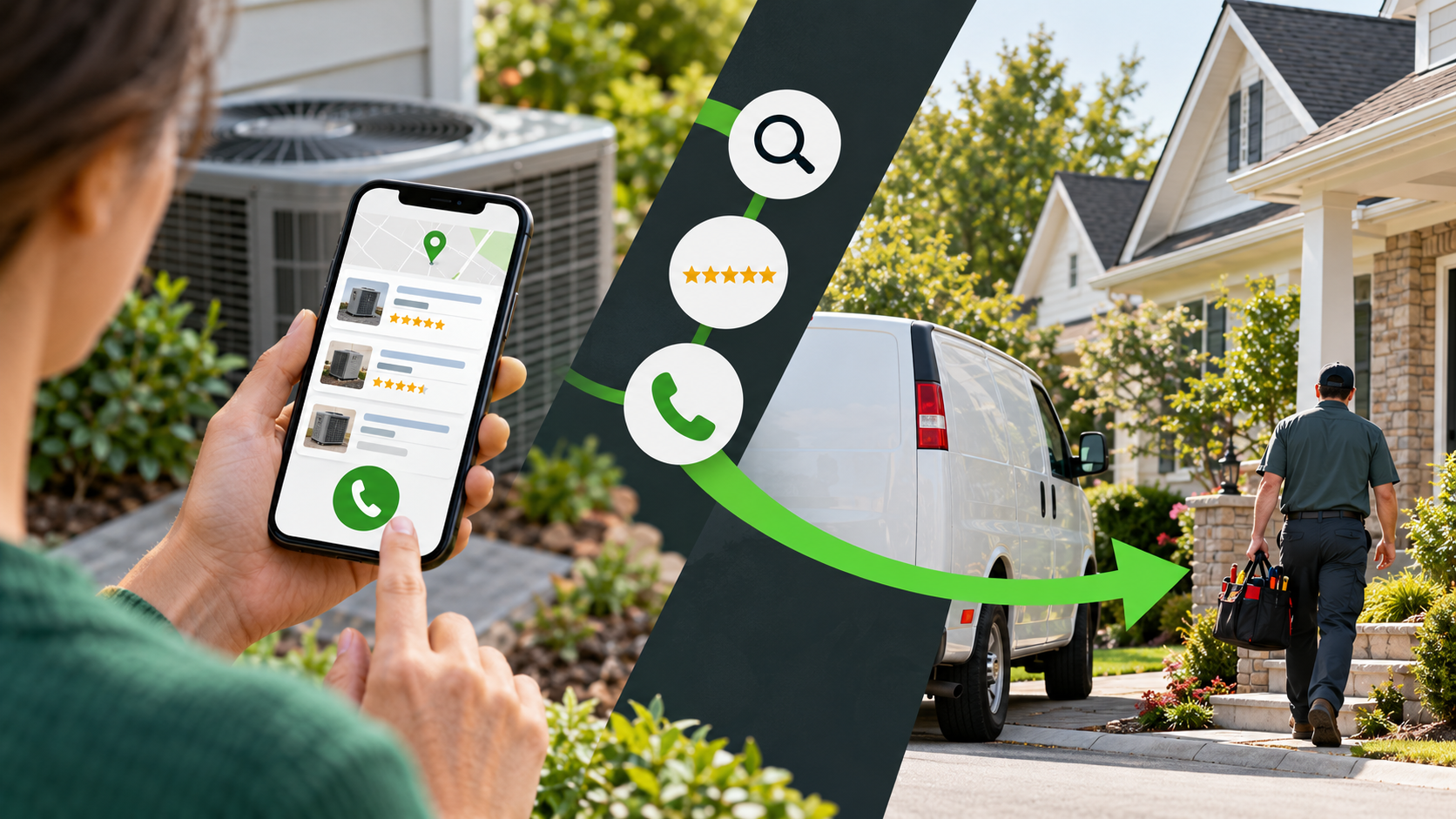
Most consumers searching for a local trade type the service plus their location — “AC repair Atlanta,” “drain cleaning near me.” If your business doesn’t show up in the local 3-pack on Google, you’re invisible to most of that demand.

The single highest-leverage move is claiming and fully completing your Google Business Profile. That means accurate business name and phone number, complete hours, high-resolution photos, video if you have it, and a service-area definition that matches reality. Add posts regularly. Answer questions.

From there, layer in technical SEO on your own site: a unique page for each service area, location-specific keywords in your H1s and meta descriptions, fast page-load speeds, and mobile-responsive design. If you serve ten towns, build ten location pages. Each one is its own shot at ranking in a different local search.

Local SEO isn’t a one-time project. It’s a discipline. Update your GBP monthly, generate fresh reviews continuously, and build out new content as you expand into new markets.

See Related Article: 10 Proven Ways to Generate Plumbing Leads in 2026

3. Build a Website That Converts — Not Just Impresses

Your website is not a brochure. It’s your home base, and it has one job: convert the traffic your other marketing channels send to it.

Colleen Keyworth, Director of Sales and Marketing at Online-Access, says that a website is your “mothership” — with a sharp distinction: “Websites are trapping, not hunting.” SEO and ads bring people to the site. The site converts them. If you have great ads and a bad site, you’re paying to send traffic somewhere that loses money.

Keyworth suggests a few things to audit on your website today:

Use real photos of your real team. Not stock photos. Not AI-generated images. In an era where consumers are increasingly suspicious of polished, perfect content, the brands that win are the ones that look human. Hire a local photographer for half a day, get headshots and action shots of every tech, and replace every stock photo on your site this month.

Put financing options on every relevant page. Most customers will need a way to spread payments out on larger jobs. Make it visible, not buried.

Include a careers page. Every employee you’ll ever hire will check it. Every customer who admires your work might recommend a friend. It’s a free recruiting funnel.

Test it on mobile. Most home service searches happen on a phone. If your booking form doesn’t work cleanly on an iPhone, your website doesn’t work.

4. Get Google Reviews Systematically

Reviews are a confirmed Google local ranking factor and the most-cited factor in consumer decision-making for home services. Companies with 4.5+ star averages and high review volume win the click before anyone reads a word.

The most consistent way to generate reviews is to ask, every job, every time. The cleanest systems automate the request via text the moment a job is closed. Don’t rely on the customer’s memory. Don’t rely on the tech remembering to ask. Build the request into your CRM workflow.

Respond to every negative review professionally. Don’t argue. Acknowledge, offer to make it right, and move on. The response is for the next prospect reading, not for the existing complainer.

Track reviews across Google, Yelp, Facebook, and any platform that matters in your area. Some of the leakage you’ll find when you do this is staggering — a single rude CSR, one chronic underperformer in the field, or one truck that always shows up late can quietly drag your rating down for months before anyone notices.


LEAD MAGNETS - Download graphic for articles-4


5. Run PPC and Google Local Services Ads — With Eyes Open

Pay-per-click ads put your business at the top of the page for high-intent searches. Local Services Ads put you above PPC, with the Google Guaranteed badge as a trust signal. Both work. Both can also burn cash if poorly managed.

The strategy itself is straightforward: research the keywords your customers actually use, write ad copy that matches the search intent, and send clicks to a landing page that loads fast and makes it easy to book. Track cost per lead, cost per booked job, and revenue per ad dollar — not just clicks.

Here’s the part most articles won’t mention. Many marketing agencies charge a percentage of your ad spend as their fee. That model creates a direct conflict of interest — the agency makes more money the more you spend, regardless of whether the spend is working. Colleen Keyworth pointed this out on the TNFR podcast: when her team brought PPC management back in-house, they built a model where the contractor keeps their own Google Ads account, the agency charges a flat management fee, and there’s no incentive to over-spend.

When you evaluate a paid-ads partner, ask three questions: Who owns the ad account? How are you compensated? Can I see revenue tied to ad spend, not just impressions? Anyone who can’t answer those clearly is a partner you should pass on.

6. Use Social Media for Trust, Not Virality

The contractors who win on social media are almost never the ones chasing viral moments. They’re the ones who show up consistently with real, human content.

Jen McKee, founder of Kee Hart Marketing, uses what she calls the 3S framework: Show Up, Standout, and Sell. 50% of your content is “Show Up” (behind the scenes, team birthdays, training days, community), 30% is “Standout” (educational content, thought leadership), and 20% is “Sell” (services, offers, promotions). The biggest mistake she sees is contractors flipping that ratio and posting nothing but offers. The algorithm punishes it because users scroll past, and the platform learns to deprioritize the account.

A second 2026-specific point most articles miss: social media is now a search signal. Google indexes TikTok, YouTube, Instagram, and Facebook video and surfaces those results when people search for local services. Large language model search engines do the same. A consistent video presence on TikTok and YouTube isn’t just a social play — it’s an SEO play.

The last point is the most important: Use real footage of real techs. A contractor in Anaheim told McKee that his customers now mention seeing him on TikTok before he even gets to the door. That recognition isn’t just good marketing. It’s a comfort signal that drops the customer’s defenses before the truck rolls up.

Skip AI-generated video for now. Audiences are still calibrated against it, and consumers actively distrust it. The brands that win in 2026 will look more human, not less.

7. Email Marketing and Database Reactivation

Email remains one of the highest-ROI channels in marketing. For home services, the leverage is even higher because most contractors are sitting on a database of past customers they’re not actively marketing to.

Three plays to run immediately:

A “we miss you” reactivation campaign. Pull every customer you haven’t seen in two-plus years. Send a short, personal email or text with an easy-to-book offer — a tune-up, a drain check, a no-cost system inspection. The database you already paid to build is the cheapest list you’ll ever market to.

Aging-equipment triggers. If your CRM tracks equipment install dates, set up automatic outreach when a system hits seven, ten, or fifteen years. Those are replacement conversations the customer would rather have proactively than at midnight when the unit dies.

New-homeowner welcomes. Buy or partner with a list provider for new movers in your service area. They’re high-intent, often haven’t picked a service provider yet, and are more receptive than the typical homeowner.

The cheapest customer you’ll ever acquire is the one you already have. Email is how you keep them.

8. Build a Multi-Touch Follow-Up Cadence

Most home services estimates get followed up on once, maybe twice. Closing typically takes more touches than that — sometimes many more. That gap, between what most contractors actually do and what closing actually takes, is where unsigned estimates pile up and quietly die.

Brennen Smith, a fractional CMO and owner of Compass Fractional, says that when he starts with a new client, the first place he looks is open estimates in their dispatch software. The number is usually somewhere between $2 million and $4 million, sitting untouched.

Two practical fixes:

Stop calling it follow-up. Customers can feel the salesy energy of a “just following up” call. Reframe every touch around the customer’s problem. “I wanted to make sure your family had the issue with the water heater resolved” lands very differently than “just checking in on the estimate.”

Mix the channels. Phone, text, email — across days, not within hours. A reasonable cadence: same-day text, next-day phone call, three-day email, one-week follow-up text with a soft offer, then a monthly touch for the next three to six months. Automation tools make this trivial to set up.

Build a real cadence and the close rate on existing pipeline climbs — without spending another dollar on ads.

9. Build B2B Partnerships and Own Your Community

Some of the highest-converting leads in home services come from referrals — not customer referrals, but trade-to-trade referrals. Plumbers who refer to HVAC companies. HVAC companies who refer to electricians. Home inspectors who hand off mold and foundation issues. Realtors who recommend a trusted provider to every new homeowner they close.

Brennen Smith recommends formalizing these relationships rather than letting them happen by accident. Take three or four reputable companies you’d be proud to refer to dinner. Talk about what makes a great handoff. Then put an actual structure in place — a referral fee per closed job, a quarterly review meeting, a shared definition of what a “great lead” looks like. Track it in writing. Pay on time. Both sides win, the customer wins because they get a vetted provider, and you turn an informal favor into a measurable channel.

Community presence is the parallel play. Pick the neighborhoods you want to own and become unmistakable there — block parties, sponsorships, branded swag, school events, charity drives. None of these are clever ad tricks. All of them compound over years into the kind of brand recognition no ad budget alone can buy.

See Related Article:  HVAC Leads: How to Generate Better Jobs (Not Just More Calls)

10. Show Up on Video — But Stay Human

Video is the format consumers now expect. Short-form video for social, longer educational content for YouTube, before-and-after walkthroughs for your website. Every smartphone is a 4K camera. There is no excuse not to be producing video in 2026.

The point of video is not polish. It’s trust. The customer who watches three videos of your team before booking has effectively met them. They know what to expect when the truck pulls up. That’s a closer-to-the-sale starting point than any cold ad can produce.

Two practical guardrails:

Use your actual team. Not actors, not AI avatars. Real techs, in real homes, doing real work. The clunkiness is the point.

Don’t outsource the voice. A marketing agency can help you edit, schedule, and distribute, but the personality has to come from inside the company. Customers can smell agency-produced content from a mile away, and the trust signal disappears.

For contractors who feel awkward on camera: it gets easier. Start with one weekly post. Document what your team did this week. Within a quarter, it stops feeling weird.


The Marketing ROI Lever Most Guides Won’t Tell You About: Your Pricing Structure

Now to the part of this article that no other home services marketing guide will give you.

Everything above works. Every tactic is real. But there’s a ceiling on how much any of it can earn you, and that ceiling is set by something most marketing advice never mentions: the math on every truck roll.

Brennen Smith put it most directly: “Pricing is the most important thing you could do that would drastically change your business very quickly.” That’s a fractional CMO saying it, not a pricing consultant. Marketing leaders see this because they watch contractors pour money into ads while the per-call economics quietly bleed out the back end.

Here’s the math, courtesy of The New Flat Rate Vice President, Matt Koop.

A healthy home services business allocates roughly 25% of revenue to labor, 25% to materials, 25% to overhead, and 25% to profit. To hit that ratio, your billable rate has to be roughly five times your highest-paid technician’s hourly cost. If your top tech earns $40 an hour, your billable rate needs to be at least $200 an hour — at perfect efficiency.

But efficiency is never perfect. The average traditional flat-rate contractor sells around 900 to 1,100 hours per year against 2,080 paid hours. That’s roughly 50% efficiency. Diagnostic-only calls, vacation, sick days, slow periods, and traffic eat the rest.

When you divide your target rate by your real efficiency, the math gets uncomfortable. A $200/hr target at 50% efficiency means you actually need to bill $400/hr to hit your margin. Most contractors don’t do that math. They charge $179, $189, $200 — numbers that feel comfortable but quietly leave them at 2-3% profit instead of 25%.

Here’s what this has to do with marketing. If your billable hour is underpriced by 30-40%, every marketing dollar you spend converts at a fraction of what it could. The same $200 lead that produces a $500 ticket at one company produces an $1,800 ticket at the next. The first company can’t afford to scale ad spend. The second can.

See VP Matt Koop break the math down in this video.

This is the lever most home services marketing content won’t talk about. Software vendors sell products that help you generate and track leads. They have no commercial incentive to point out that the highest-leverage thing you could do is fix the pricing math underneath those leads. Danielle Putnam, CEO of The New Flat Rate, makes this point on the TNFR podcast: you can’t save money you don’t make, and you can’t scale marketing on margins you don’t have.

There’s one more piece. When you give customers a single price, you’re giving them a binary: take it or leave it. When you give them multiple options at different price points, you’re letting them tell you what they actually want to buy. Most pick something better than the single-price version would have been. That’s not pressure selling. That’s how every other industry, from car dealers to hotels to coffee shops, has worked for decades.

This is what The New Flat Rate was built to do. The New Flat Rate menu pricing system gives every tech a structured way to present multiple options at the kitchen table, raising average tickets without raising customer pressure. Contractors using it consistently see efficiency rates climb from the traditional 50% to 65% or higher — and at 65% efficiency, your true billable hour drops from $400 closer to $300. That’s not a price cut. It’s a structural fix to the same math that was bleeding you dry.

If you’re spending money on marketing and not seeing the revenue you expected, this is almost always where the leak is.

See Related Article: How to Build a Profitable Service Business Without Overspending

How to Choose a Home Services Marketing Partner

If you’re considering hiring a marketing agency or partner, the standard advice — check reviews, ask for case studies, see if they work in your trade — is fine, but it’s not where most contractors get burned. Here’s what to actually look for:

Watch the fee structure. Agencies that charge a percentage of your ad spend make more money the more you spend, full stop. That’s a misaligned incentive. Flat-fee management with the contractor owning the ad account is a cleaner model.

Ask what they audit. Any partner who only tracks impressions, clicks, and form fills is half-doing the job. The good ones audit your call recordings, your booking rate, your estimate conversion rate, and the revenue per booked job. That’s where the actual money is.

Test their understanding of the system. A marketing partner who can’t talk about CSR training, follow-up cadence, in-home conversion, and average ticket as part of the marketing conversation is going to sell you traffic, not revenue. Run the other way.

Look for trade specialization. General-purpose marketing agencies struggle with home services because the buying cycle, customer psychology, and economics are unique. Specialists move faster and waste less of your money.

Ask for revenue-based case studies. Not impressions. Not lead volume. Closed-ticket revenue tied to ad spend. If they can’t show it, they probably haven’t been tracking it.

You can engage a partner for a one-time strategy build, for ongoing execution, or somewhere in between. The model matters less than the alignment.


Your Next Step

Most home services marketing advice tells you how to get more calls. That’s the easy half. The hard half is making sure every call is worth as much as it possibly can be when it converts.

Run the strategies above. Fix your call capture. Build the follow-up cadence. Get on video. Own your community. But also, this week, look at one number: your average ticket. If it’s not where it should be, no amount of marketing is going to fix the math underneath it.

That’s what we help with at TNFR. If you want to see what your business looks like with menu pricing in place — and what marketing ROI looks like when the back end is fixed — See how The New Flat Rate works by booking a demo.

Either way: build the system. Then turn up the volume.