

5 min read
The Service Agreement That Keeps Your Customer Isn't the Same One That Makes You Money
The New Flat Rate : Aug 25, 2026, 7:45:00 AM
Table of Contents
The Service Agreement That Keeps Your Customer Isn't the Same One That Makes You Money
By The New Flat Rate
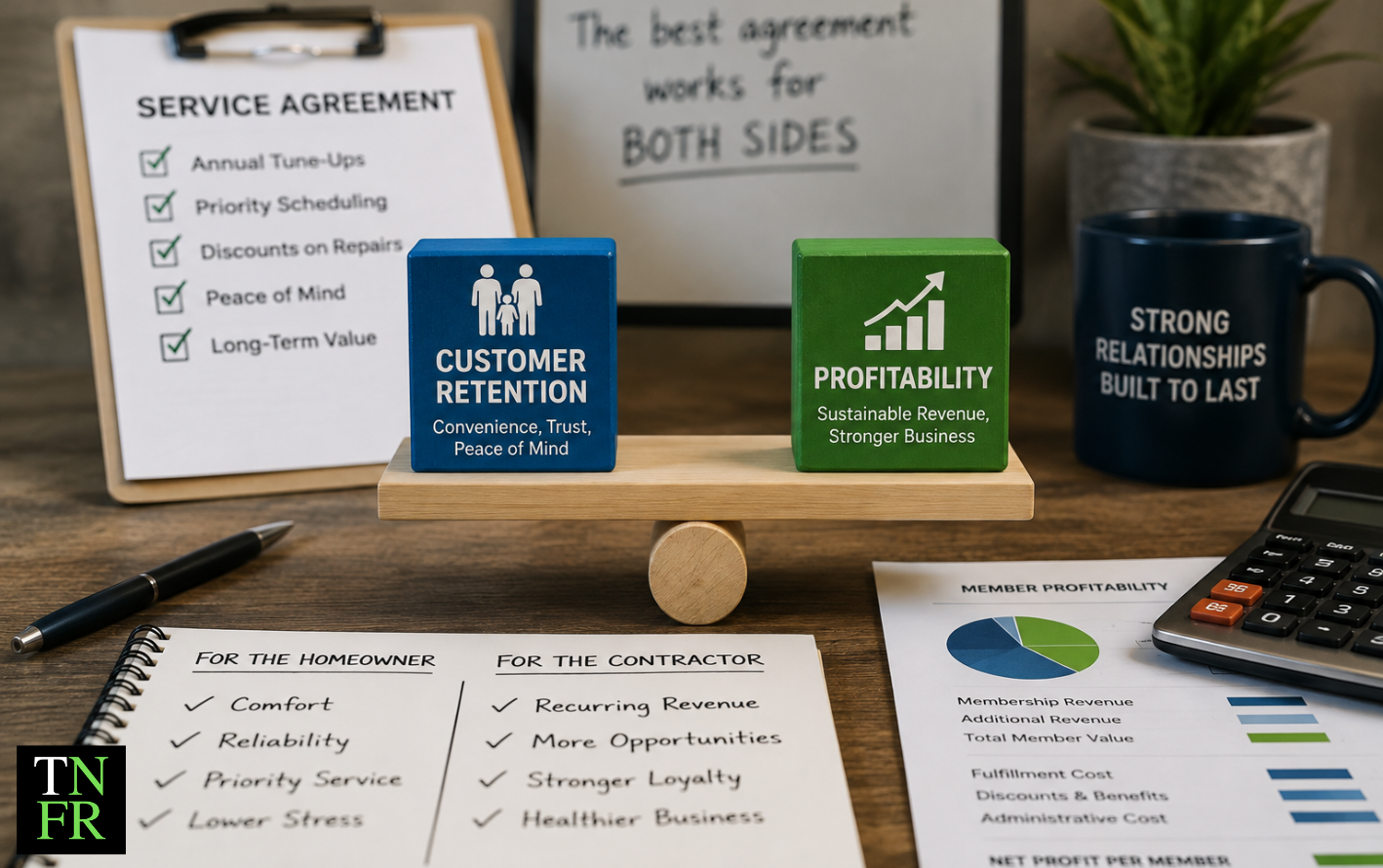
A successful HVAC service agreement has to do two jobs: give the homeowner a reason to stay and give the contractor a reason to keep serving them. Those aren't automatically the same thing.
A service agreement can have strong renewal rates, thousands of members and customers who genuinely love it—and still quietly lose money. That's because retention answers one question: Did the customer stay? Profitability answers another: Was serving that customer financially worth it?
Contractors often assume that if a membership keeps customers coming back, it's doing its job. But if the agreement is underpriced, overloaded with discounts or consuming expensive technician capacity without creating enough additional revenue, growth can actually make the problem worse.
The goal isn't simply to build a service agreement customers don't want to cancel. It's to build one that's worth renewing for both sides.
Can an HVAC service agreement have high retention and still lose money?
Yes. An HVAC service agreement can have excellent retention and still lose money if the membership fee and additional revenue generated by the customer don't cover the actual cost of fulfilling the agreement.
Consider a $20-per-month membership that produces $240 per year. If the contractor promises two annual maintenance visits, those visits require more than technician wages. There's drive time, truck expense, fuel, payroll burden, scheduling, dispatch, office support and the opportunity cost of occupying a service slot. Add repair discounts or waived service fees throughout the year, and that $240 in recurring revenue may not be nearly as valuable as it first appeared.
The customer may love the agreement. The renewal rate may look fantastic. And the contractor may still be subsidizing the relationship.
Retention is a metric. It isn't the business model.
Retention matters because an existing customer can be considerably more valuable than one you have to replace every year.
Imagine two HVAC companies with 1,000 service agreement customers. Company A retains 90% of its members but earns very little—or even loses money—fulfilling each agreement. Company B retains 80%, but its members consistently purchase legitimate additional repairs, replacements and upgrades that make those relationships profitable.
Which company has the better membership program?
You can't answer that question with retention alone.
The same problem appears elsewhere in a contracting business. A company can generate more leads without producing more profit, add technicians without becoming more efficient, and add service agreement members without creating a healthier company. Growth magnifies whatever economics already exist underneath it.
We explore that larger problem in HVAC Business Growth: A Practical Guide for Contractors at Every Stage.
What actually makes an HVAC service agreement profitable?
A profitable HVAC service agreement has to account for both the cost of fulfilling the agreement and the value created by the ongoing customer relationship.
A simple starting point is:
Annual Member Value = Membership Revenue + Member-Generated Revenue
Then compare that against:
Annual Member Cost = Maintenance Fulfillment + Discounts + Service Benefits + Administrative Cost
The relationship needs to make financial sense after both sides are considered.
But there's another important piece: a maintenance visit isn't just a cost. It's also an opportunity. Your technician is already inside the home, looking at the equipment, and may find aging components, indoor air quality problems, efficiency opportunities or repairs that the homeowner should know about.
If the technician completes the tune-up, changes the filter and leaves, the company received the membership payment but may have missed much of the economic value of having an established customer relationship. That doesn't mean technicians should manufacture repairs or pressure homeowners into buying something they don't need. It means homeowners should be shown the legitimate options available when a problem or opportunity exists.
Your membership gets you back into the house. Your pricing system determines what happens next.
That's an important distinction. A service agreement creates access and continuity, while your pricing and presentation system helps determine the economic value of that relationship. You need both.
If your membership gets you into 1,000 homes every year but technicians aren't consistently identifying needs and presenting legitimate options, the program can become an expensive calendar-filling machine. Your technicians and trucks stay busy and the dispatch board stays full, but the financial return doesn't necessarily follow.
That's why we encourage contractors to look beyond activity when evaluating profitability. Our HVAC Pricing Guide: 8 Bottlenecks That Are Costing You Revenue looks at several other places where revenue can leak out even when the company appears busy.
How do you know if your HVAC service agreement is actually profitable?
Start by separating membership success from membership profitability. Determine what the agreement really costs you to fulfill—not just technician wages, but the real cost of putting that technician at the member's home. Include drive time, truck expenses, payroll burden, dispatching, administrative support and the opportunity cost of occupying that service slot.
Then account for the benefits you're giving members. Discounts, waived service fees, priority scheduling and other perks all have economic value.
Now compare those costs with the revenue generated by the entire member relationship. That includes the membership fee, but it should also include repairs, replacements, indoor air quality work and other legitimate services members purchase throughout the year.
Finally, compare members with non-members. Are members actually more valuable customers? Do they purchase more, stay longer, accept more recommended work or generate more revenue over the relationship?
If you don't know, that's probably the first thing worth measuring.
Don't solve an unprofitable agreement by automatically raising the membership price
If a service agreement isn't profitable, the obvious reaction is to charge more. That may be the answer, but price isn't the only lever.
The problem could be an underpriced membership, excessive discounts, too many included visits, inefficient scheduling, expensive fulfillment, technicians failing to present legitimate additional options or a pricing system that doesn't adequately cover the company's costs when members purchase repairs.
Those are very different problems, so before changing the agreement, determine where the economics are actually breaking.
The same principle applies to contractor pricing overall. Sometimes the price itself isn't the problem; the system surrounding the price is. That's why choosing an HVAC pricing app should involve more than simply asking whether the software can produce a number.
Service agreements shouldn't exist just to keep the schedule full
Service agreements can make a company look incredibly healthy. You have thousands of members, maintenance season is booked, technicians have work and customers keep renewing. Those are all positive signals, but a full schedule isn't necessarily a profitable schedule.
If low-value maintenance visits consume the technician capacity you need for higher-value opportunities, the agreement can create a strange situation where the thing designed to strengthen the business begins limiting it.
This becomes especially important during peak season because technician hours, truck capacity and appointment slots are finite. Every business eventually has to decide where those resources create the most value.
That's why service agreement strategy can't live separately from pricing, dispatch, marketing and capacity planning. If you're investing heavily to bring new customers into the business while an existing membership program is consuming capacity without producing sufficient value, spending more on lead generation may not solve the underlying problem.
Our guide to Marketing for Home Services: 10 Strategies That Drive Revenue can help you think about customer acquisition as part of the larger revenue system rather than as an isolated activity.
What should a profitable service agreement actually accomplish?
The goal isn't to squeeze every possible dollar out of a member, and it isn't to make the agreement so contractor-friendly that homeowners stop seeing value in it. The best service agreements create alignment.
The homeowner gets something worth keeping: convenience, maintenance, priority, confidence and an ongoing relationship with a contractor they trust. The contractor gets something worth maintaining: recurring revenue, lower customer acquisition pressure, predictable demand and repeated opportunities to serve an existing customer.
If only the contractor wins, customers cancel. If only the customer wins, the contractor eventually changes or eliminates the program. A sustainable service agreement has to work for both.
The question contractors should ask about their service agreements
Instead of only asking how many members you have or what your renewal rate is, ask:
"What is one service agreement customer actually worth to our company after we fulfill everything we promised them?"
That question forces you to look at the entire relationship—membership revenue, fulfillment costs, discounts, additional work, technician capacity, retention and lifetime value.
Because the service agreement that keeps your customer isn't automatically the service agreement that makes you money.
The best one does both.
Ready to see what your service agreements are really worth? Learn how to sell service agreements that build lasting, profitable customer relationships.