

5 min read

The Most Expensive Time to Fix Your Pricing System Is After You Grow

The Most Expensive Time to Fix Your Pricing System Is After You Grow

The Most Expensive Time to Fix Your Pricing System Is After You Grow

By The New Flat Rate


If you already know your flat-rate pricing needs work, “later” can sound reasonable.

Your current price book still functions. Your technicians are comfortable with it. You've put countless hours into it. Changing now may slow profit this quarter, so you tell yourself to wait a little while longer.

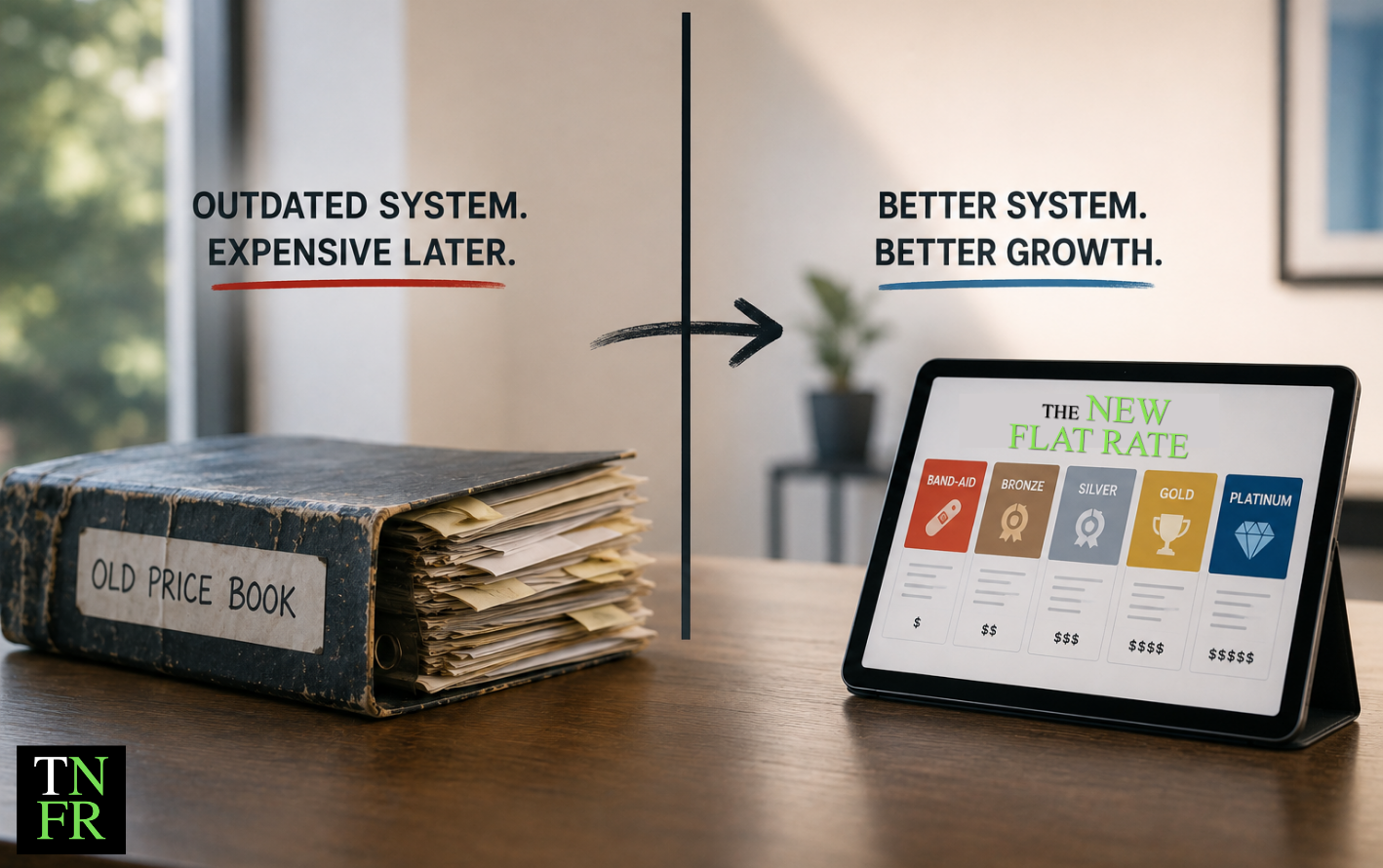
But in truth, the best time to replace a failing pricing system is before more people learn the old one, before workarounds become habits, and before you have years of pricing logic to unwind.

This article is for home service contractors who already have a price book but know it isn’t the system they want to grow with. If your pricing works today but you’re seeing inconsistency, technician judgment, or old habits creeping in, fixing it now will be easier than retraining everyone later.

A Price Book Can Work and Still Be the Wrong System

Contractors often judge a price book by one question:

Does it give my technician the correct price to charge?

We've seen contractors spend hundreds of hours building their own price books. They update parts, labor, tasks, and prices.

Then they see The New Flat Rate and realize something frustrating.

Their price book answers:

“What should I charge?”

But it doesn't necessarily answer:

“How should my technician present this to the customer?”

We've seen what happens when that distinction gets ignored.

A few years ago, a TNFR member was part of a co-op with several other home service companies. When they joined the co-op. they left from TNFR to the price book the group was using.

The implementation went fine.

Their average service ticket did not.

It immediately went down.

They quickly, told the co-op of their new pricebook issue, and returned to TNFR with other home service co-op members in tow.

What’s the takeaway?

Changing software isn’t bad. It’s good. But, A clean implementation can't make the wrong pricing structure perform like the right one.


Your Technician Shouldn't Become the Pricing System

Pricing starts breaking down when the price book leaves too much of the decision to the technician.

A technician walks into a home and decides:

“They can't afford this.”

So they don't show all the choices.

Another technician says:

“This is an easy fix.”

Then they give the price.

The customer just heard easy. Before seeing the number, they may already believe the repair shouldn't cost much.

Another technician presents only the repair they personally think the customer should buy.

They may believe they're helping.

But they're making the customer's financial decision for them.

Your pricing system should give the customer the information and let the customer choose.

That's also why one-option pricing creates a problem.

If you only offer one option, the customer will create a second one in their mind. And it may not be you.

They can wait. Call someone else. Search online. Or do nothing.

Your billable hour needs to be right.

Your options need to be built.

And your technician needs a repeatable way to present them.

Not sure your billable hour is covering what it actually costs you to run a truck? Download the free Truck Roll Cost Calculator and see the real number before you build another price around a guess.


The Old Price Book in the Van Is Not a Safety Net

Here's one of the easiest ways to weaken a new flat-rate pricing implementation:

Keep the old price book around “just in case.”

The team trains on the new system.

Then a technician gets into a call where the new process feels uncomfortable.

The old method is sitting right there. They know it. They trust it. They don't have to think about it.

So they go back.

A backup price book quickly becomes a competing price book.

That's one reason TNFR doesn't treat implementation as handing someone a login and hoping they use it.

TNFR works with owners and technicians through the change. Technicians call the field support team during at least their first five TNFR calls so they can ask questions while they're actually using the pricing process with customers.

The point isn't simply to teach them which buttons to press.

It's to help the new pricing process become the comfortable one before they fall back into old habits.

The Price Book You Spent 100 Hours Building May Still Be the Wrong Tool

This part hurts.

Some contractors have spent hundreds of hours building their own price books.

And that's exactly why replacing one can be so difficult.

You've invested nights and weekends into parts, prices, tasks, labor, and updates.

But a well-built list of prices can still leave one big problem unsolved.

How does the technician present those prices to the customer?

Equipment sales often get this right. Contractors may already present multiple options when someone needs a replacement.

Then a service technician walks into the next home and gives the customer one repair and one price.

That's not the same experience.

Your price book shouldn't only tell you what something costs.

It should help the technician present value and give the customer choices.

Changing Prices Is Easy. Changing Habits Takes Time.

This is the cost contractors don't always calculate when they say they'll fix pricing later.

You can replace software.

You can update prices.

You can correct your billable hour.

But now your technicians also have to stop doing what they've practiced for years.

Stop deciding which customers can afford certain options.

Stop showing only the repair they personally prefer.

Stop softening the price by calling the work “easy.”

Stop going back to the old price book when something gets uncomfortable.

The longer the old pricing process stays in place, the more familiar those behaviors become.

So waiting doesn't necessarily reduce disruption.

It can create more of it later.

“I Wish I Had Done This Years Ago”

We hear some version of that regularly from TNFR members.

One contractor told us that if he had known what the results would be, he would have refinanced his house to purchase The New Flat Rate sooner.

Another member said:

“From a pricing standpoint, TNFR has been the best investment ever in our organization in our 15 years of operation.”

Their regret wasn't that they changed pricing.

It was how long they waited to put the right pricing structure in place.

Fix the Pricing Before More People Learn the Old Way

Your current price book may be good enough for today.

That's not the best question.

Ask:

Is this the pricing system I want the next person on my team to learn?

If the answer is no, every person you teach the old process to becomes someone you may eventually have to retrain.

Get the billable hour right.

Build the options.

Put the pricing presentation in place.

Then let your technicians get good at the system you actually want to keep.

Don't wait until your pricing problem is bigger before replacing it.

Fix your pricing before growth makes the old way harder to undo.


Frequently Asked Questions


When should a home service company switch to flat-rate pricing?

A home service company should switch before more technicians become dependent on the old price book. Putting accurate pricing, customer options, and a repeatable pricing presentation in place earlier means fewer pricing habits have to be undone later.


What should be in place before changing price books?

Start with a correct billable hour and customer options. Then train technicians on how to present the new pricing and remove easy access to the old method so they don't fall back on it when the new process feels uncomfortable.


Every uncomfortable moment your technician spends deciding what to charge or what to show a customer has a real dollar cost behind it. Find out what those moments are actually costing you with our free Truck Roll Cost Calculator — then see how The New Flat Rate fixes the pricing system before it fixes you.

If you already know your current price book is something you'll eventually replace, see what The New Flat Rate looks like before you spend another year getting better at the old way.

Get a Free Demo of The New Flat Rate.