

 Melody Chaney

An electrical proposal template is a document that explains the job, equipment, options, prices, and terms a customer can approve before work begins. Use the panel replacement example below, then customize a proposal with The New Flat Rate’s free proposal template builder.
The New Flat Rate helps electrical contractors present clear pricing options without putting pressure on technicians to sell. While this free proposal builder supports both three-option and five-option layouts, TNFR's complete Menu Pricing System uses five done-for-you options, giving homeowners more choices while allowing technicians to focus on service.
Last updated: Oct 26, 2026
Key takeaways
- Name the exact equipment and work included in the price.
- Include required safety, code, permit, and inspection work in every applicable option.
- Separate optional improvements from work needed to complete the job properly.
- Record the selected option, full price, and written approval.
Download the electrical proposal template
Choose electrical in the proposal builder, select three or five options, and rename the options to match your team’s presentation. Add your company details and logo, review the live preview, and use the PDF output shown in the builder. Anything left blank stays a fillable field on the PDF.
Customize your electrical proposal template
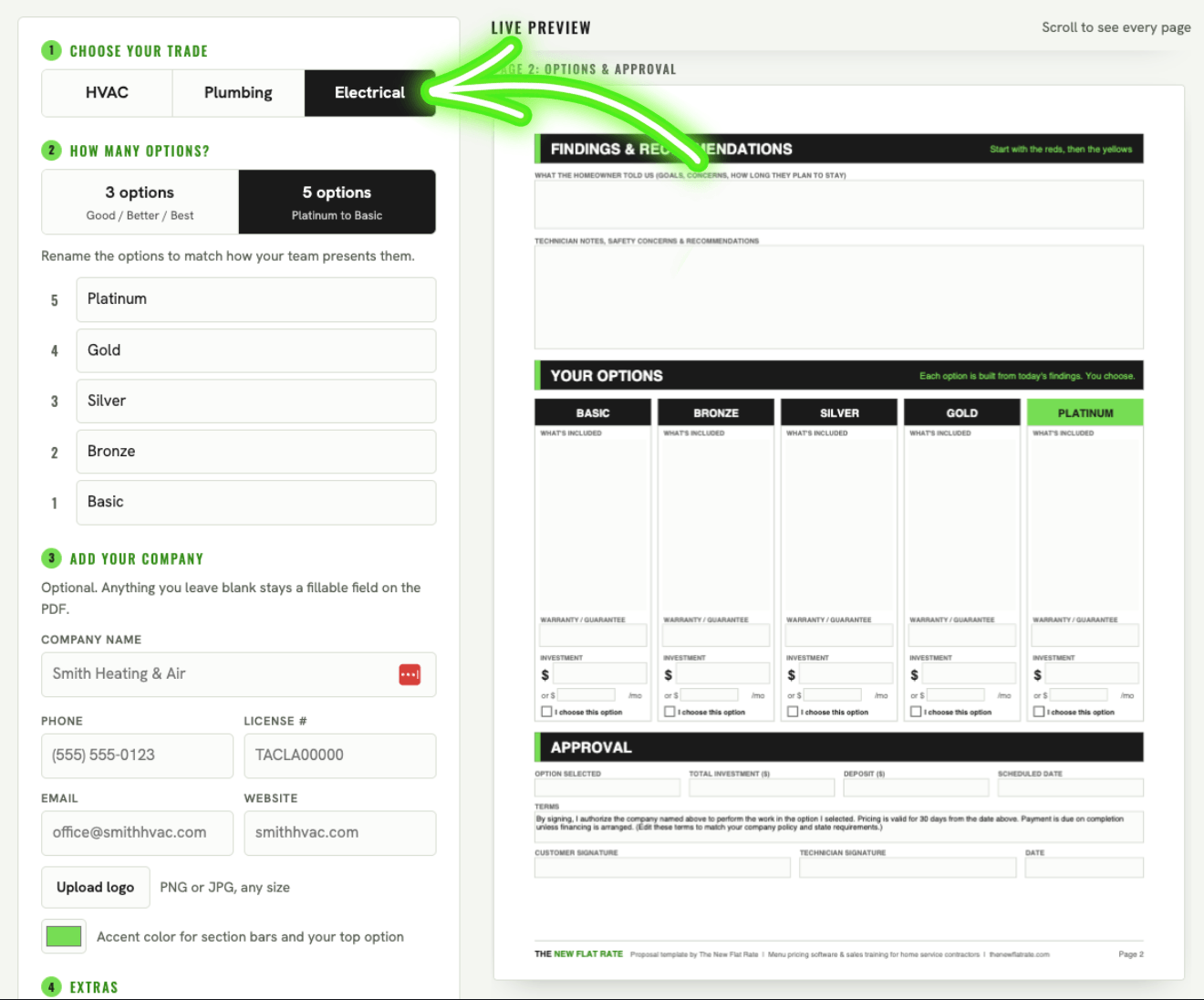
Proposal builder preview: trade selection, company details, pricing options, warranty fields, and customer approval.
What should an electrical proposal include?
An electrical proposal should identify the customer and location, define the scope, list equipment, explain each option, and state the full price and terms. For panel work, it should also address service capacity, permit and inspection responsibilities, shutdown coordination, and exclusions.
- Business and customer details: company name, contact information, applicable license details, customer name, and service address.
- Proposal details: proposal number, issue date, expiration date, and contact for questions.
- Diagnosis and scope: the problem found, proposed solution, and limits of the work.
- Equipment: panel rating, manufacturer, exact model, compatible breakers, and other specified materials.
- Options and prices: the work included in each package, total price, and treatment of taxes and fees.
- Permits and inspection: who obtains permits, schedules inspections, and coordinates with the utility if needed.
- Schedule and access: expected work duration, power interruption, access needs, and scheduling dependencies.
- Warranty: contractor labor coverage and separate manufacturer coverage.
- Terms and exclusions: payment schedule, unlisted work, and approval for scope changes.
- Acceptance: customer’s selected option, final total, signatures, and date.

What does a professional electrical bid example look like?
A professional electrical bid example defines a specific job and makes its price and limits clear. This fictional proposal covers replacement of an existing 200-amp panel at the same service rating and location; it does not assume a service-capacity upgrade is needed or included.
Example contractor: Sample Electrical Company. Customer: Avery Example. Proposal: EL-208. Issued: October 20, 2026. Valid through: November 3, 2026. All names, dollar amounts, and warranty terms below are illustrative—not TNFR prices, customer results, or market-rate benchmarks.
| Item | Good | Better | Best |
|---|---|---|---|
| Panel scope | Same-rating 200-amp panel replacement; final model and breakers specified before approval | Same panel scope as Good | Same panel scope as Good |
| Added scope | All applicable required protection, permits, inspection, testing, and labeling | Good + review of up to 10 accessible circuits + 2 specified receptacle replacements | Better + assessed 120V/20A garage circuit, up to 25 accessible feet |
| Illustrative total | $3,200 | $3,700 | $4,500 |
| Warranty | Illustrative 1-year labor coverage; manufacturer terms separately attached | Same labor and manufacturer treatment | Same labor and manufacturer treatment |
| Financing | Not included in this example | Not included in this example | Not included in this example |
| Taxes and fees | Included in this fictional total | Included in this fictional total | Included in this fictional total |
Common scope in all options: remove and replace the existing panel; install specified compatible breakers; perform applicable grounding, bonding, testing, labeling, and required protective-device work; coordinate required permits and inspection. Any surge protection or other work required by the applicable code belongs in every option, not only a higher package.
Sample line items: Good totals $3,200. Better includes Good plus a $300 diagnostic review of up to ten accessible circuits and $200 of two specifically identified receptacle replacements, totaling $3,700. Best adds a separate $800 dedicated 120-volt, 20-amp garage circuit to Better, totaling $4,500; its stated route is limited to 25 accessible feet.
The garage circuit is an optional convenience addition, not an EV charging offer. These examples assume the added circuit is supported by the completed assessment; a circuit is not added merely to create a higher-priced package. Every option must fully address the diagnosed condition within its stated scope.
Sample schedule: one working day, subject to utility coordination, permit approval, and inspection availability. Sample payment: balance due at completion. Exclusions: service-capacity increase, utility fees not expressly included, concealed damage, trenching, and wall repair; additional scope requires a written price and approval.
Acceptance: Avery Example selects Better at $3,700. Customer signature: __________________. Contractor signature: __________________. Approval date: __________________. Obtain the actual customer’s signatures only after confirming the final scope, equipment, total, and terms.
While this example uses three options to demonstrate a basic electrical proposal, The New Flat Rate teaches a different approach: presenting systems instead of individual parts. Rather than simply quoting a price to replace a breaker, outlet, or panel, technicians present five options that address the customer's problem at different levels of service. This gives homeowners more control over their decisions while allowing electricians to focus on solving problems instead of selling parts.
How do you write an electrical bid proposal?
Write an electrical bid proposal by assessing the site, defining the required work, calculating the price, and documenting responsibilities and exclusions. Then present only suitable options, explain what changes between them, and record the customer’s written approval before work begins.
- Document the customer’s concern and your findings.
- Confirm the equipment, service conditions, capacity assessment, and applicable requirements.
- Define the required scope and separate it from optional additions.
- Calculate labor, materials, overhead, permit costs, and your profit requirement.
- Check the equipment list, totals, schedule, and warranty terms.
- Review the proposal with the customer and capture the selected option.
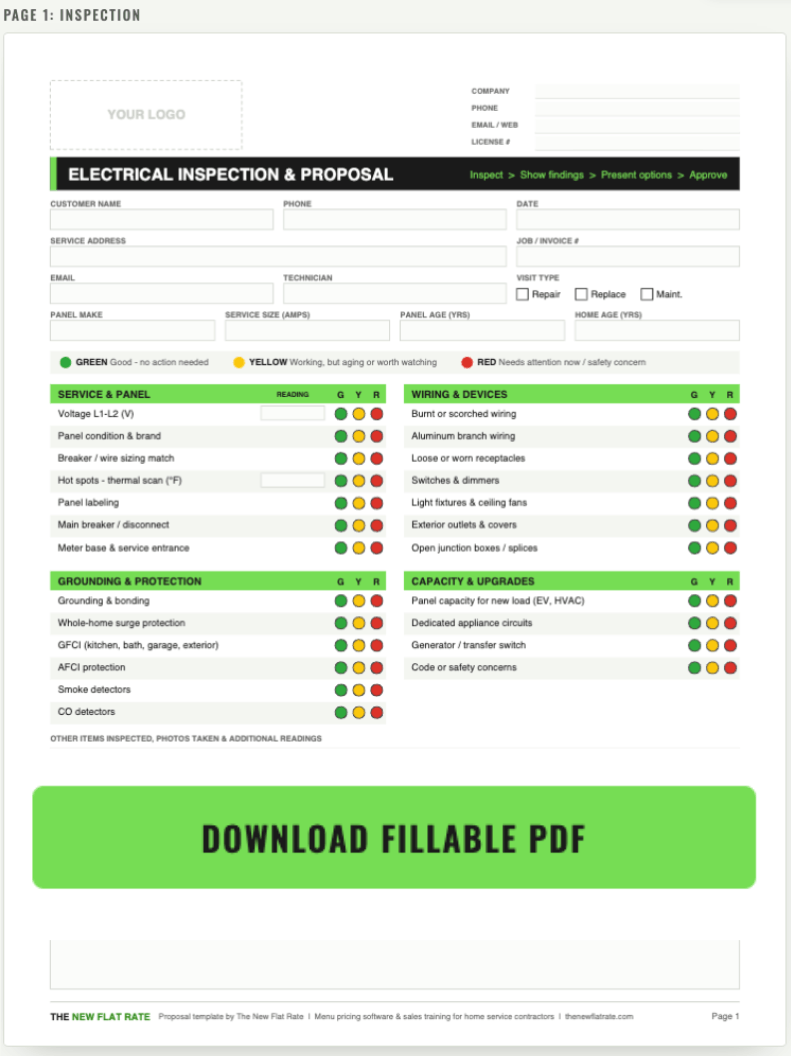
Inspection preview: record findings before presenting options.
The Electrical Safety Foundation International recommends qualified electricians and identifies training, licensing, insurance, and bonding among the qualifications it describes. Your proposal should give customers clear business credentials and identify who is responsible for the work; verify local requirements for the job.
Read ESFI’s guidance on qualified electricians.
Electrical bid vs. proposal vs. estimate
An estimate projects the likely cost, a bid offers a price for a defined scope, and a proposal explains the work and choices offered. The label alone does not tell the customer what is guaranteed; spell out the scope, price basis, validity period, and process for changes.
| Document | Practical meaning |
|---|---|
| Estimate | An expected cost based on known conditions; state how and when it may change. |
| Bid | A price offered for a defined scope; state inclusions, exclusions, and validity. |
| Proposal | A written explanation of the recommended scope, options, prices, and approval terms. |
Five electrical proposal mistakes to avoid
A clear electrical proposal addresses equipment, required work, pricing, scheduling, and approval. The issues below are practitioner guidance about avoiding confusion; they are not measured claims about close rates or customer outcomes.
- Calling a panel replacement an upgrade without defining it. State whether capacity, location, equipment, or only the panel changes.
- Making required protection a premium feature. Include all applicable safety and code work in every relevant option.
- Leaving equipment vague. Specify panel rating, model, compatible breakers, and any separately offered equipment before approval.
- Ignoring power interruptions and scheduling. Explain utility and inspection dependencies without promising dates you cannot control.
- Using one price for undefined work. List exclusions and obtain written approval before changing the scope or total.
The U.S. Consumer Product Safety Commission publishes a Home Electrical Safety Checklist covering topics such as outlets, cords, and circuit breaker boxes. It is a useful customer education resource; it does not replace the professional assessment or the specific scope written into a proposal.
View the CPSC Home Electrical Safety Checklist.
How does menu pricing help with electrical proposals?
Menu pricing presents clearly priced choices with meaningful differences in scope or benefits. A price book is the organized set of tasks and prices supporting those choices; a proposal records the customer’s options, terms, and approval.
Choose the three-option or five-option layout in the free builder, then fill each option from your findings and the customer’s priorities. The example above uses three options; the five-option layout gives you two additional choices to define. TNFR’s Menu Pricing System and training support a consistent presentation process beyond the template itself.
Explore TNFR’s electrical menu pricing software.
See contractor training and coaching.
Browse more free contractor templates.
Electrical proposal template FAQs
Can you recommend some professional electrical bid examples?
Use examples that show a specific job, equipment, scope, full price, exclusions, and acceptance. The panel replacement example on this page shows how three packages can be compared. Adapt it to the actual assessment and your local requirements rather than copying its prices, equipment assumptions, or warranty terms into a live job.
What is an electrical proposal?
An electrical proposal is a written offer describing the work a contractor recommends, what it costs, and the terms for completing it. It may include several options. The customer should be able to identify the scope they are approving, what is excluded, and how extra work will be handled.
What should an electrical bid proposal include?
Include contractor and customer details, the job location, scope, equipment, price, permit responsibilities, schedule, warranty, payment terms, exclusions, and approval. For panel projects, clarify the service rating and whether a service-capacity increase is included. Identify power interruption and utility coordination needs so the customer can plan around the work.
How do I price an electrical proposal?
Calculate the price from your labor, materials, overhead, permit costs, and profit requirement for the defined scope. Check site access, equipment compatibility, and scheduling dependencies before you commit. Use your company’s pricing method and current supplier costs; the illustrative totals in this article are examples of presentation, not recommended prices.
Should permits and inspections appear in an electrical proposal?
Yes. State who handles required permits and inspections, whether their costs are included, and how they affect scheduling. Identify any necessary utility coordination as well. Verify requirements with the local authority for the actual project instead of assuming the same process applies to every panel replacement, circuit addition, or service upgrade.
Can I offer good, better, and best electrical options?
Yes, when each option is suitable and the differences are meaningful. Include all required safety and code work in every applicable option, then describe optional additions separately. Avoid packages that suggest the lower-priced option leaves a known required correction undone. Explain exactly what the customer receives for each approved total.
Does an electrical proposal template replace pricing software?
A template organizes the written offer; it does not calculate every job or create a consistent presentation process by itself. Pricing software can support how technicians build and present choices. TNFR provides menu pricing and training, while the proposal documents the selected scope, price, and approval for the specific job.
Make your next electrical proposal easier to understand
Show the work, the options, and the full price in one place. If your technicians need a consistent way to present choices, see how The New Flat Rate’s electrical Menu Pricing System works.