

5 min read
Plumbing Proposal Template: How to Write One Homeowners Actually Sign
 Chloe Sackett
:
Oct 22, 2026, 7:45:00 AM
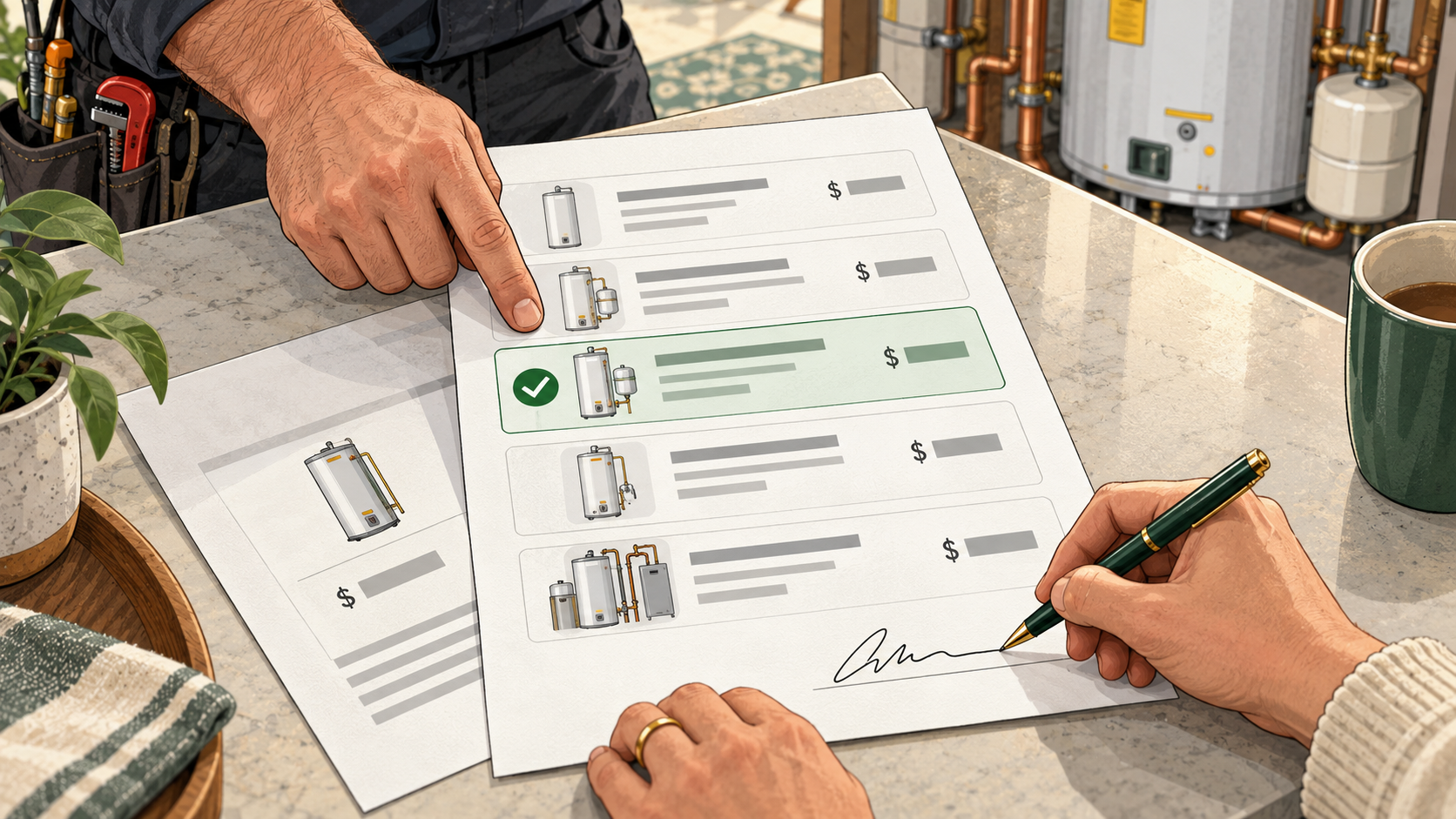
A homeowner is holding two quotes for the same water heater replacement. The first lists labor hours, a parts total, and one price at the bottom. The second gives her five options, each with one complete price and a plain description of what she gets. She calls the second plumber back. What should a plumbing proposal include? Start with what you found, then give the homeowner choices instead of a single yes-or-no number. Below is every section a residential proposal needs, plus a plumbing proposal template built as a five-option menu you can adapt for your own service calls.
This is for residential service plumbers working in homeowners' kitchens and basements, not commercial bids headed to a GC or property manager.
Quote or Proposal: Which Does the Job Need?
A quote answers one question: how much? A proposal answers the question the homeowner is actually asking: what are my options, and what do I get with each one? A clogged kitchen drain needs a quote. A water heater that quit, a sewer line that keeps backing up, or a leak under the slab needs a proposal.
| Quote | Proposal | |
|---|---|---|
| What the homeowner gets | A price for one fix | A set of options and what each one includes |
| Best for | Small, single-fix jobs like a running toilet or a clogged drain | Bigger repairs and replacements with more than one way to fix the problem |
| How many prices | One | One per option |
If you already use a plumbing estimate template or plumbing quote template for small calls, keep using it. The proposal is for the jobs where the homeowner has a real decision to make.
What Should a Plumbing Proposal Include?
A residential plumbing proposal should include your company and customer info, what you found on the visit, a menu of options with one complete price each, and a place for the homeowner to choose and sign.
- Company and customer info, plus how long prices are valid
- What you found on the visit
- Five options, not one price
- Approval and signature
Company and Customer Info, Plus How Long Prices Are Valid
Put your company name, license number, and contact info at the top, along with the homeowner's name, address, and the date. Add an expiration date. Material costs move, and a price that never expires is a price you'll eventually lose money on. A clear deadline also gives the homeowner a reason to decide now instead of shopping it around for a month.
What You Found on the Visit
Write two to four sentences, in plain language, about what's wrong. For the water heater above, that might read: "Your 12-year-old water heater stopped heating because a part failed, and there's heavy sediment in the tank. There's no expansion tank, and the shutoff valve above the heater is corroded."
The homeowner needs to understand the problem before they look at a single price. If they don't know what's wrong, every option looks like an upsell.
Five Options, Not One Price
A proposal with one price leaves the homeowner a yes or no. When the answer is no, they rarely negotiate. They call someone else.
Menu pricing gives them a better decision to make. Instead of one price, you lay out five complete ways to solve the same problem, from the most complete fix down to the minimum, and the homeowner chooses. The top option covers everything you'd recommend for the long run. The bottom option, the Band-Aid, gets them through today. The options in between let them land where their budget and priorities are. Warranty coverage should climb with each option too, since the more complete the fix, the longer you can stand behind it.
That changes the conversation. The homeowner stops judging whether your one number is fair and starts choosing which fix fits them. Building five options by hand on every call is slow, which is why shops that price this way use a menu pricing system like The New Flat Rate to build them for the tech before they knock on the door.
One Set Price per Option
Each option gets one set price that covers everything in it. Leave the labor hours or parts costs off the page.
Itemizing invites homeowners to do math you didn't ask them to do. They compare your parts line to the shelf price at the hardware store, question the hours, and start crossing off lines. One complete price keeps the conversation on what they're getting. The math still matters, but it belongs in how you build the price, not on the proposal.
Approval and Signature
End with a place for the homeowner to mark the option they chose, sign, and date. Writing down the chosen option matters as much as the signature. If there's ever a question about what was included, the answer is on the page.
The Plumbing Proposal Template
Use this structure for any residential job where the homeowner has more than one way to fix the problem.
[Company name] | License #[number] | [Phone] | [Email]
Customer: [Name]
Service address: [Address]
Date: [Date] | Prices valid through: [Date]
What we found
[Two to four sentences in plain language: what's wrong, what's causing it, and anything else you noticed that affects the fix.]
Your options
| Option | What you get | Warranty | Price |
|---|---|---|---|
| Option 1 | [The most complete fix, in plain language] | [Coverage] | [$] |
| Option 2 | [What you get] | [Coverage] | [$] |
| Option 3 | [What you get] | [Coverage] | [$] |
| Option 4 | [What you get] | [Coverage] | [$] |
| Option 5 | [The minimum fix that gets them through today] | [Coverage] | [$] |
Your choice
Option chosen: [Option 1, 2, 3, 4, or 5]
Customer signature: ____________ Date: ________
Technician: ____________
[Lead magnet CTA goes here once the template download is built. Delete this note before publishing.]
How to Write It So It Gets Signed
Use Plain Language
The homeowner doesn't need the model number or the pipe spec. They want to know two things: will this fix it, and how long will it last? Write every option so it answers both.
Lead With What You Found
Compare "This proposal covers water heater service" with "Your water heater stopped heating because a part failed, and the sediment in the tank means it's near the end of its life." The first sounds like paperwork. The second tells the homeowner you looked.
Add One Line of Proof
One short review from a nearby homeowner does more than a page of claims about your company. Pick one that matches the job and leave it at that.
Want the next one in your inbox?
Pricing, sales, and keeping good techs — plus training and events as they come up.
FAQ
Should I break out labor and parts on a plumbing proposal?
Not on residential service work. Give each option one complete price. Itemized labor and parts push homeowners to compare your parts against store prices and haggle over hours, which pulls the conversation away from what they're getting.
Is a plumbing bid template the same as a plumbing proposal template?
Not usually. Bids are typically for commercial or new construction work, where a GC or property manager compares detailed scopes from several contractors. A residential proposal is for service calls where the homeowner chooses how to fix a problem.
Why five options instead of three?
Most homeowners rule out the top and bottom options before they look closely at anything else. The top feels like more than they need, and the bottom feels like a risk. Decision researchers call this extremeness aversion: people tend to steer away from the ends of a set of choices and lean toward the middle.
With three options, that leaves one real choice, which puts you right back to a single price. With five, three solid options remain in the middle, and the homeowner still has a real decision to make. Five also covers the full range, from the most complete fix to a Band-Aid that gets them through today, so you have an option that fits almost any budget.
What's the difference between a plumbing estimate and a proposal?
An estimate gives a price for one fix, usually on small, simple jobs. A proposal lays out what you found, your options, and one price for each, so the homeowner can choose.