

5 min read
HVAC Flat Rate Pricing Examples: 10 Common Repairs Priced From Your Billable Hour
 Chloe Sackett
:
Nov 25, 2026, 7:45:00 AM
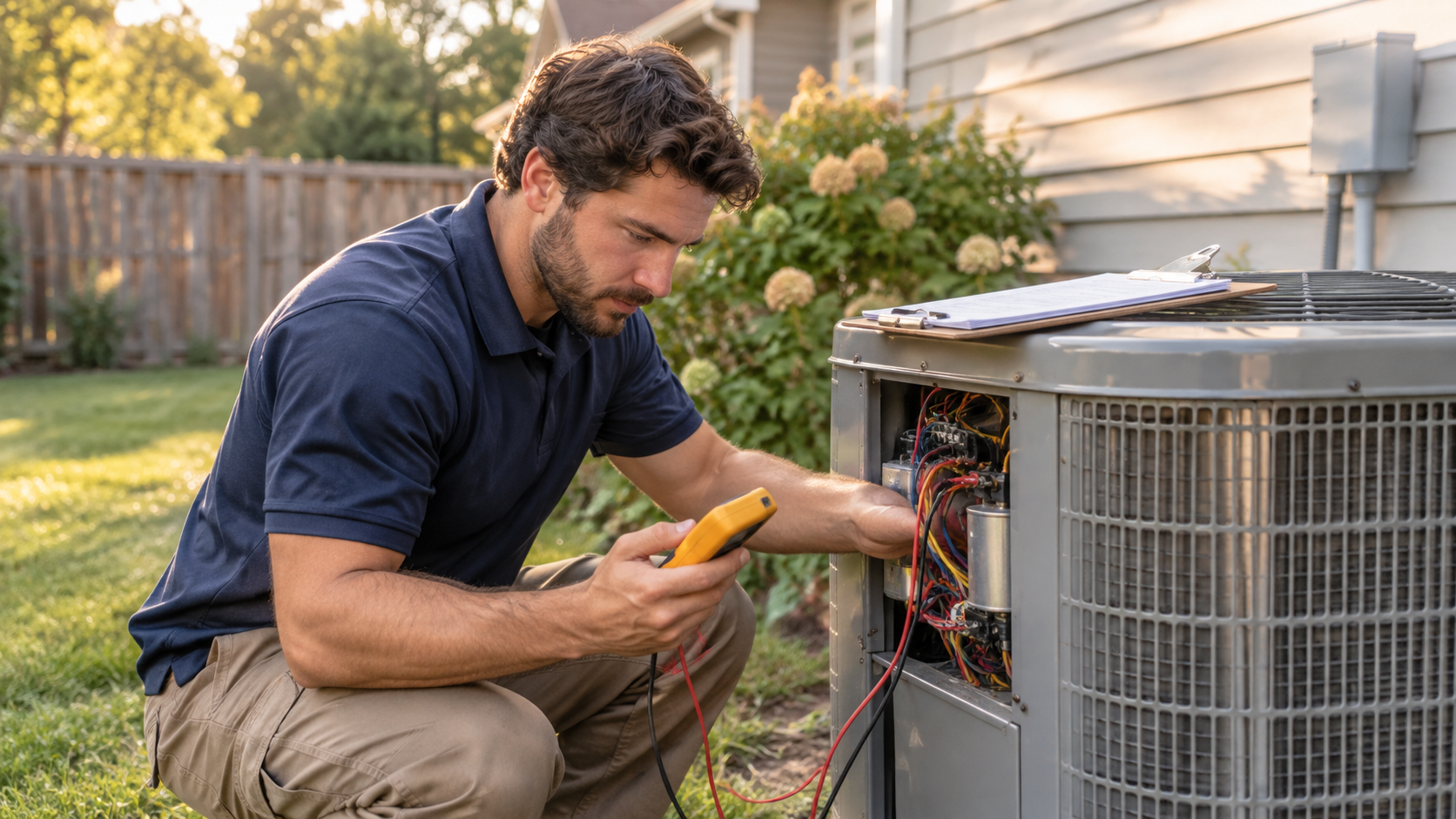
Most HVAC flat rate pricing examples published online share a problem. The prices are real numbers, but nothing connects them to each other, so you cannot tell what would happen to any of them if your costs changed. Here are ten, all built from one billable hour, with the arithmetic left in.
The short answer
Every line on an HVAC pricing sheet is the same calculation: your billable hour times the real task time, plus the part at your markup, plus your service fee. Set those three inputs once and all ten repairs below price themselves. Change the billable hour and every line moves together, which is what a price book is supposed to do.
Why published price books fall apart when you check them
We worked through three contractor-facing HVAC price books. All three publish confident numbers. None of them survives arithmetic.
One applies a flat 3x markup to every part, including a $850 coil, which produces $2,550 in parts on one line. The same page calls a flat multiplier the most common price book mistake and publishes a tier chart that would price that coil closer to $1,700. Its own table breaks its own rule.
One labels a column "Profit (20%)" when the figure in it is simply price minus cost. On its capacitor line that works out to about 78% of the price, not 20%. The page also states a method, divide your cost by 0.80, that none of its own table prices follow.
One gives a formula that adds parts at cost, then separately publishes markup tiers running from 1.5x to 7x. Both cannot be the build. Its summary table also disagrees with its own detailed list: the ignitor is $220 to $480 at the top of the page and $199 to $299 further down.
None of the three says where any number came from.
That is the real problem with borrowing a price book. It is not that the numbers are too high or too low. It is that they are disconnected, so when your insurance renews or you give a raise, you have no idea which lines to move.
Useful HVAC flat rate pricing examples have to show their working, which is what the table below does.
The three inputs behind every line
Your billable hour. Loaded labor plus overhead, divided by the hours you can actually invoice. Not the wage, and not the hours you pay for.
The real task time. Drive, diagnosis, the work, the test, the cleanup, the paperwork. If you are timing the wrench only, every line below is already wrong.
The part at your markup. Tiered, not flat. A $25 capacitor and a $450 blower motor should not carry the same multiplier, because the cheap part costs you nearly as much to stock, carry and warranty as the expensive one.
Then add your service fee, which is what the truck cost to get there whether or not you sold anything.
10 common HVAC repairs, priced from one billable hour
These are the repairs that appear across essentially every published HVAC price book. Everything below runs on a $300 billable hour and a $100 service fee, with parts marked up 3x under $50, 2.5x from $50 to $250, and 2x above that.
All the figures are illustrative. They are not benchmarks and they are not TNFR data. They exist so you can check the arithmetic and then swap in your own numbers.
| Repair | Hrs | Labor | Part | Marked up | Price |
|---|---|---|---|---|---|
| Run capacitor replacement | 0.5 | $150 | $25 | $75 | $325 |
| Drain line clearing | 0.5 | $150 | $10 | $30 | $280 |
| Hard start kit installation | 0.5 | $150 | $45 | $135 | $385 |
| Contactor replacement | 0.75 | $225 | $35 | $105 | $430 |
| Condenser coil cleaning | 1.0 | $300 | $15 | $45 | $445 |
| Evaporator coil cleaning | 1.25 | $375 | $20 | $60 | $535 |
| Condensate pump replacement | 1.0 | $300 | $60 | $150 | $550 |
| Refrigerant leak search and report | 1.5 | $450 | $20 | $60 | $610 |
| Smart thermostat, supplied and installed | 1.0 | $300 | $180 | $450 | $850 |
| ECM blower motor replacement | 2.5 | $750 | $450 | $900 | $1,750 |
Every line is labor plus marked-up part plus the $100 service fee. Add the three columns on any row and you get the price. That is the whole method, and it is the part you can take with you.
For the full walkthrough of one of these, including what homeowners see online for it and where the five options come from, we took the capacitor apart line by line in what to charge for an AC capacitor replacement.
Change one number and the whole book moves
This is what a borrowed price book cannot do for you.
Drop the billable hour from $300 to $250 and leave everything else alone. The capacitor goes from $325 to $300. The condenser coil cleaning goes from $445 to $395. The blower motor goes from $1,750 to $1,625.
Notice the shape of it. The long jobs move the most, because labor is the only input that changed. A fifty dollar swing in your billable hour costs you $125 on a two and a half hour job and $25 on a half hour one.
Which means the reverse is also true. If your billable hour is wrong, the error is biggest on exactly the jobs where you can least afford it.
What each line still needs
A price is not a presentation. Each of those ten lines should open into five options the homeowner can choose from, and the repair itself is only the first one.
Two rules worth holding. Anything code requires goes in every option, including the cheapest, because code is never an upgrade. And the cheapest option still has to leave you whole, or you have built a job you would rather not win. The five-option structure is worth reading properly before you build it.
Two costs are missing from the table above and belong in your real numbers: callbacks, which are a job you already got paid for and are still paying for, and the member discounts you give away on agreements, which need pricing backward from the real cost of a visit.
At The New Flat Rate we make flat rate menu pricing software, training and coaching for home service contractors in HVAC, plumbing, electrical, chimney and indoor air quality. On TNFR menus, roughly 80% of customers choose an option above the cheapest one, typically within fifteen to twenty seconds. The billable hour sits underneath all of it, and the homeowner never sees it.
HVAC flat rate pricing FAQs
What should my HVAC billable hour actually be?
Whatever your own loaded labor and overhead divided by your real billable hours says it is. The $300 used above is illustrative, chosen so the arithmetic is easy to follow. Published ranges vary enormously and none of them knows your payroll, your drive times or your truck costs.
Should I use the same parts markup on every part?
No, and a flat multiplier is the fastest way to price yourself out of big-ticket repairs. A $25 capacitor can carry three times its cost comfortably. The same multiple on a $450 motor adds nine hundred dollars to a line you still have to win against a competitor.
Do I add the service fee on top or roll it in?
Either works as long as every line on the sheet does it the same way and your technicians know which it is. The common failure is a sheet where some prices include the fee and some do not, so nobody can explain the number at the door.
How often should I rebuild my HVAC pricing sheet?
Rebuild when an input moves, not on a schedule. A raise, a new truck, an insurance renewal or a supplier increase all change your billable hour, and if the sheet is built properly you update one number rather than fifty lines.
Free calculator
Get the one number the whole sheet runs on
Every line above moves when your billable hour moves. The Billable Hour Calculator works yours out from your wages, burden, overhead and the hours you actually invoice, so the rest of the sheet has something real to stand on.
✔ Your loaded cost per billable hour
✔ Break-even and target rate side by side
✔ Free download